
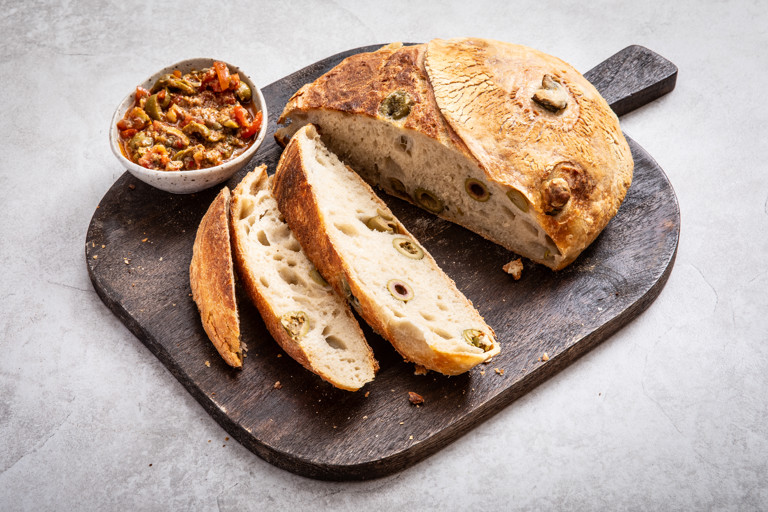
Dirty martini sourdough with olive dipping oil
- medium
- Makes 1 loaf
- 1 hour 40 minutes plus 1 hour resting time, 3 hours bulk fermentation time and overnight proving time
Hannah Wellock has used the dirty martini cocktail as inspiration for her olive sourdough loaf. Fragata’s green olive brine adds a rich salinity to the dough itself and the olives add pops of butter and pepper. The bread is served with an olive dipping oil using cherry tomatoes and Fragata’s anchovy-filled manzanilla olives for a rich, umami and slightly sweet flavour with Parmesan, garlic and capers. Fantastic as a starter or bread course.
Ingredients
Metric
Imperial
DOUGH
- 160g of Fragata pitted green olives, drained and brine reserved (from 1 x 335g jar)
- 180g of warm water, approximately 32°C, (see step 1)
- 400g of strong white bread flour, plus extra for dusting
- 100g of 00 flour
- 125g of sourdough starter, fed the night before
- 10g of fine sea salt
DIPPING OIL
- 100ml of olive oil
- 2 tbsp of balsamic vinegar
- 1/2 lemon, zested and juiced
- 1 garlic clove, finely grated
- 120g of cherry tomatoes, diced
- 3 anchovies, finely chopped into a paste
- 150g of Fragata green olives filled with anchovy, chopped
- 2 tbsp of Fragata capote capers, finely chopped into a paste
- 1/2 tsp red pepper flakes
- 40g of Parmesan
Equipment
- proving basket
- bread lame (razor blade) or small sharp knife
Method
Start the dough the day before you want to serve the bread. Drain the jar of olives into a colander set over a bowl. Set the olives aside and measure out the brine – you should have around 170g. Top up with the 32°C water to get a total weight of 350g
- 160g of Fragata pitted green olives, drained and brine reserved (from 1 x 335g jar)
- 180g of warm water, approximately 32°C
Combine the water-brine mixture with the flours in a stand mixer fitted with a dough hook. Mix for 3½ minutes on a low speed until combined. Cover with a tea towel and leave to rest for 45 minutes
- 400g of strong white bread flour
- 100g of 00 flour
Add the starter and mix for 10 minutes on a low speed, then add the salt and mix on a medium-high speed for 2 minutes until well combined and cohesive
- 125g of sourdough starter, fed the night before
- 10g of fine sea salt
Cover and leave the dough to bulk ferment for 1 hour
Add the olives to the top of the dough and, using wet hands, grab one side of the dough, stretch it upwards, then fold it over the centre. Repeat this 3 times, rotating the bowl 90 degrees each time
Cover and leave again for 1 hour
Repeat the above folding process then leave for 1 more hour
After this hour, the dough should look aerated and feel stronger – if it hasn’t increased in volume by at least 50-75% at this point leave for another 30 minutes to 1 hour, until aerated – how quickly the dough ferments will depend on the temperature of the dough and kitchen
Carefully tip the dough out onto a work surface – you want to keep it aerated. Shape it into a round using a dough scraper by tucking the edges under and pulling it towards you to create surface tension on the top. Leave to dough to rest for 15-20 minutes (dust the top with a little flour and cover with a tea towel if its drafty in the kitchen, to stop it drying out)
- strong white bread flour, for dusting
Dust a banneton proving basket and the work surface with flour
- strong white bread flour, for dusting
Using a dough scraper, gently but confidently flip the dough over onto the floured surface so the bottom is now the top. Pull the outsides in over the top, stitching together to create surface tension on the bottom, then gently roll the dough up tightly and tuck in the edges with your hands so the dough is a tight and round shape – try not to rip the surface of the dough
Transfer to the banneton, seam-side upwards then cover with a tea towel. Place in the fridge for 8-12 hours
The next day, preheat the oven to 230°C with a dutch oven inside for 30-45 minutes – it needs to be very hot. If you don’t have a dutch oven you can preheat a pizza stone or thick baking tray in the middle of the oven with a roasting tray on the bottom of the oven
Using oven gloves, remove the dutch oven and take off the lid (be careful as it will be very hot)
Gently invert the dough onto a square of baking paper and score the top with a razor blade or small sharp knife. Transfer the bread on the paper into the dutch oven then use oven gloves to put the hot lid back on
Bake for 20 minutes. Alternatively, if you’re baking on a pizza stone, transfer the dough onto the stone, add a generous splash of water into the roasting tray underneath to create steam and bake for 30-40 minutes, or until cooked through and a golden brown colour to your liking
After 20 minutes with the lid on, carefully remove the dutch oven and remove the lid. Return the pot to the oven and bake uncovered for a further 20-30 minutes, or until the bread is cooked through and a golden brown colour to your liking
Transfer the bread to a wire rack to cool
As the bread cools, make a puttanesca-inspired dipping oil. In a bowl, whisk together the olive oil, balsamic vinegar and lemon zest and juice until emulsified. Add the remaining ingredients and mix well. Transfer to a small serving bowl and set aside in the fridge until you’re ready to serve
- 100ml of olive oil
- 2 tbsp of balsamic vinegar
- 1/2 lemon, zested and juiced
- 1 garlic clove, finely grated
- 120g of cherry tomatoes, diced
- 3 anchovies, finely chopped into a paste
- 150g of Fragata green olives filled with anchovy, chopped
- 2 tbsp of Fragata capote capers, finely chopped into a paste
- 1/2 tsp red pepper flakes
- 40g of Parmesan
Slice and serve the cooled bread with the dipping oil
Brought to you by
In association with
Brought to you by
In association with
Hannah is a big foodie and keen baker with a focus on sourdough, which she shares on her Instagram account @foodmotivated.hannah.
Get in touch
Please sign in or register to send a comment to Great British Chefs.