
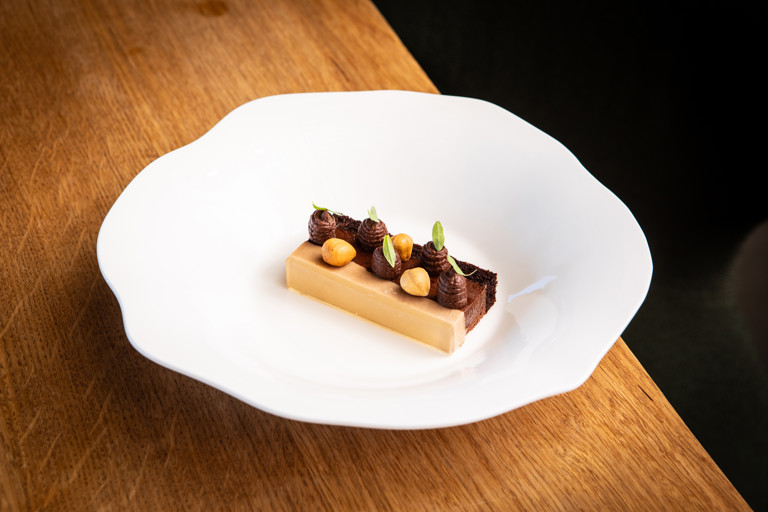
Malt mousse with blackout coffee sponge and lemon
- medium
- 8
- 1 hour 20 minutes plus cooling and setting
A four-layer cake combining the flavours of coffee, chocolate, malt and lemon, Elly Wentworth's dessert is a tour de force. The layering of the cake may take some time but it's something you can do well in advance of serving.
Elly says: 'This recipe is built around coffee, something we take very seriously at Fowlescombe Farm. Ours is by Bristol-based roasters, Easy Jose, grown sustainably by indigenous communities in the Amazon rainforest of Peru and farmed regeneratively with no deforestation, pesticides and chemical additives. Their ethos ties perfectly with our own at the farm and the quality of the coffee shines through in this dessert, which also brings in lemon verbena – one of my favourite things to cook with from our greenhouse.'
Ingredients
Metric
Imperial
Blackout coffee sponge
- 25g of unsalted butter, softened
- 195g of caster sugar
- 72g of whole egg
- 95g of plain flour
- 45g of cocoa powder
- 4g of bicarbonate of soda
- 4g of baking powder
- 115ml of espresso coffee
- 22ml of whole milk
- 82g of crème fraîche
Chocolate marquise
- 145g of 70% dark chocolate, roughly chopped
- 72g of unsalted butter, diced
- 60g of egg yolk
- 72g of caster sugar
- 225ml of double cream
- 3 tbsp of cocoa powder
Coffee curd
- 50g of espresso coffee
- 75g of unsalted butter
- 7g of caster sugar
- 40g of egg yolk
- 50g of 70% dark chocolate
Malt mousse
- 160g of white chocolate
- 3 bronze gelatine leaves
- 115ml of double cream, plus 112ml double cream
- 20g of malt extract
- 28g of malt powder, such as Ovaltine
- 30g of egg yolk
Lemon verbena jelly
- 200ml of water
- 100g of caster sugar
- 75ml of lemon juice
- 4 sprigs of lemon verbena
- 2 lemon leaves
- 25ml of limoncello
- 3 bronze gelatine leaves
To garnish
- hazelnuts
- lemon verbena
Method
Start with the blackout coffee sponge. Preheat the oven to 160°C. Beat the butter and the sugar together in a stand mixer with the whisk attachment. Once fluffy, add in the whole egg and continue mixing. When combined, take the bowl from the mixer and, using a silicone spatula, gently fold in the flour, cocoa powder, bicarb and baking powder. Place the bowl back in the mixer and add the coffee, milk and crème fraîche – make sure the coffee is cold – and mix well
- 25g of unsalted butter, softened
- 195g of caster sugar
- 72g of whole egg
- 95g of plain flour
- 45g of cocoa powder
- 4g of bicarbonate of soda
- 4g of baking powder
- 115ml of espresso coffee
- 22ml of whole milk
- 82g of crème fraîche
Take a 15cm square baking tray, line with a silicone mat or sheet of baking paper and evenly spread over the cake mixture. Bake in the oven for 9 minutes, or until cooked. Once cooked, place another silicone mat or sheet of baking paper over the top of the cake
Now place a heavy tray on top, then put the cake into the fridge to press for at least 1 hour. Once pressed, remove the cake from the fridge
Now place a square 8cm mousse ring in the centre of the tray and push down to cut out a square. Do not remove the mousse ring as you will build the dessert on this ring
Next, prepare the chocolate marquise. Take a medium pan and half-fill with water. Place it on a medium heat. In a metal mixing bowl, add the chocolate and butter. Cover with cling film and place on top of the pan of water to melt. Make sure the bowl does not touch the water
- 145g of 70% dark chocolate, roughly chopped
- 72g of unsalted butter, diced
In a stand mixer, whisk the egg yolk and sugar together until pale and creamy. In another mixing bowl, whisk the cream to soft peak stage, taking care not to overwork it or it will not combine properly with the other ingredients
- 60g of egg yolk
- 72g of caster sugar
- 225ml of double cream
Mix the egg yolk and sugar with the cocoa powder, melted chocolate and butter until fully combined. Then fold in the soft cream using a spatula until just combined, taking care not to beat the air out or overwork the cream
- 3 tbsp of cocoa powder
Transfer to a piping bag and pipe into the square mousse ring, on top of the cold-pressed cake. We are looking for about 3.5cm depth of marquise in the ring mould. Smooth out with a palette knife and keep in the fridge until required
For the coffee curd, boil the espresso, butter and sugar in a small saucepan. Put the chocolate in a heatproof bowl. Whisk the egg yolk in a second heatproof mixing bowl, then pour the hot espresso mixture over the eggs to temper them
- 50g of espresso coffee
- 75g of unsalted butter
- 7g of caster sugar
- 50g of 70% dark chocolate
- 40g of egg yolk
Pour the whole mixture back into the saucepan and cook until it thickens, making sure to stir continuously as it cooks. You will know it’s cooked when the mixture coats the back of a spoon. Pour this mixture over the chocolate and mix well until everything has combined
- 50g of 70% dark chocolate
Add the curd to a piping bag and place into the fridge. This curd will last for up to 3 days. Remove from the fridge to bring back up to room temperature before serving
To prepare the malt mousse, half-fill a pan with water. Place the white chocolate in a bowl. Place the bowl on top of the pan and then put the pan on a low heat. Melt the chocolate, making sure it isn’t getting any hotter than 52°C. You should monitor this with a temperature probe
- 160g of white chocolate
In a mixing bowl filled with ice-cold water, add the bronze gelatine and allow the gelatine to bloom. When it’s bloomed, squeeze out as much water as possible and place on a tray
- 3 bronze gelatine leaves
In a separate medium pan, add 115ml double cream, malt extract syrup and malt powder and bring to the boil. Once the mixture has boiled, add this liquid to the egg yolk. Whisk well and pour back into the saucepan to cook with the egg yolk
- 115ml of double cream, plus 112ml double cream
- 20g of malt extract
- 28g of malt powder, such as Ovaltine
- 30g of egg yolk
Cook this mixture until 80°C. Make sure you’re stirring continuously so it’s not catching on the bottom of the pan. When it’s reached the correct temperature, add the gelatine and mix well. Leave on the side, until the whipped cream is ready
In another mixing bowl, whisk the remaining 112ml double cream to a soft peak stage taking care not to over-whisk or it will not combine properly with the other ingredients. Then fold the soft cream into the mix using a silicone spatula
Once all the ingredients are mixed well, pour this mousse into a piping bag. Pipe this mousse directly on top of the chocolate marquise, then smooth it off with a palette knife, making sure there are no air bubbles. Transfer to the fridge to set for 2-3 hours
For the lemon verbena jelly, add the water, sugar and lemon juice to a medium pan. Bring to the boil and pour over the lemon verbena and lemon citrus leaf. Allow to infuse for at least 2 hours
- 200ml of water
- 100g of caster sugar
- 75ml of lemon juice
- 4 sprigs of lemon verbena
- 2 lemon leaves
Once infused, add the limoncello to the liquid and mix well. Strain the liquid through a sieve and weigh all the liquid. For each 100ml of lemon liquid, set the jelly with 3⁄4 gelatine leaf. Ideally, you want 400ml, so 3 gelatine leaves to set this jelly
- 25ml of limoncello
Fill a mixing bowl with water, add the gelatine leaves to the water and allow to bloom
- 3 bronze gelatine leaves
Bring half of the lemon liquid to the boil and add the squeezed-out gelatine to the mixture. Pour in the other half of lemon liquid and stir, making sure all the gelatine is dissolved. Allow to cool
When it’s cooled completely, pour this jelly on top of the malt mousse and place back into the fridge to set. So, you should now have four layers of ingredients set and ready in your fridge before assembling
First, take the coffee curd from the fridge and allow it to come up to room temperature. Remove the large, layered ring mould from the fridge. Pull the square ring up and off the dessert. If it does not easily pull off, try using a small blowtorch around the ring mould to loosen it. Alternatively, should you not have or want to use a blowtorch, use a hot knife around the edge. You can trim off any rough edges after getting the ring mould off
Using a hot knife, slice the layered mousse into 1cm-thick, 8cm long pieces
Pipe five nice peaks of the coffee curd onto the cake, then add the roasted hazelnuts in between the coffee curd. Finish each dessert with lemon verbena leaves
- hazelnuts
- lemon verbena
Farm-to-fork cooking isn’t anything new in the British food scene. It’s a phrase that gets thrown around quite a bit; often with little substance behind it. But for Elly Wentworth, it’s a calling; the abundance and limitations of working with produce grown on-site at Fowlescombe Farm is a dream come true.
Get in touch
Please sign in or register to send a comment to Great British Chefs.