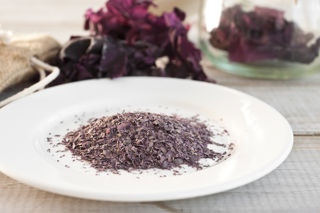
More recently seaweed made a comeback as part of the New Nordic Cuisine where gastronomic food tests with dulse proved that it was a better source of umami agents than Japanese kombu. Their tests using dulse dashi to infuse fresh cheese, ice cream and sourdough illustrated that the seaweed is a very successful flavouring agent and 'holds a great promise for novel uses not only in the New Nordic Cuisine but in general'.
In terms of home cooking, dulse can be added in its dried ground form to give flavour and nutrients to everything from seasoning lamb and adding savoury deliciousness to sauces, burgers or stews. Creating rubs, marinades and emulsions, toasting in the oven or pan frying with soy sauce, nuts and seeds, dulse can season slow-cooked roasts or be the solution to a quick, healthy lunch.
Of all the other umami-rich foods such as spring onion, cooked tomato, shiitake mushrooms, prawns, bacon, Parmesan, tuna, oysters and squid, seaweed has more glutamates. These umami-loaded foods can satisfy the palate (you experience the 'fifth taste' on a different bit of your tongue) and, if you get the balance of flavours right, can be the ultimate comfort food.