Cal Byerley
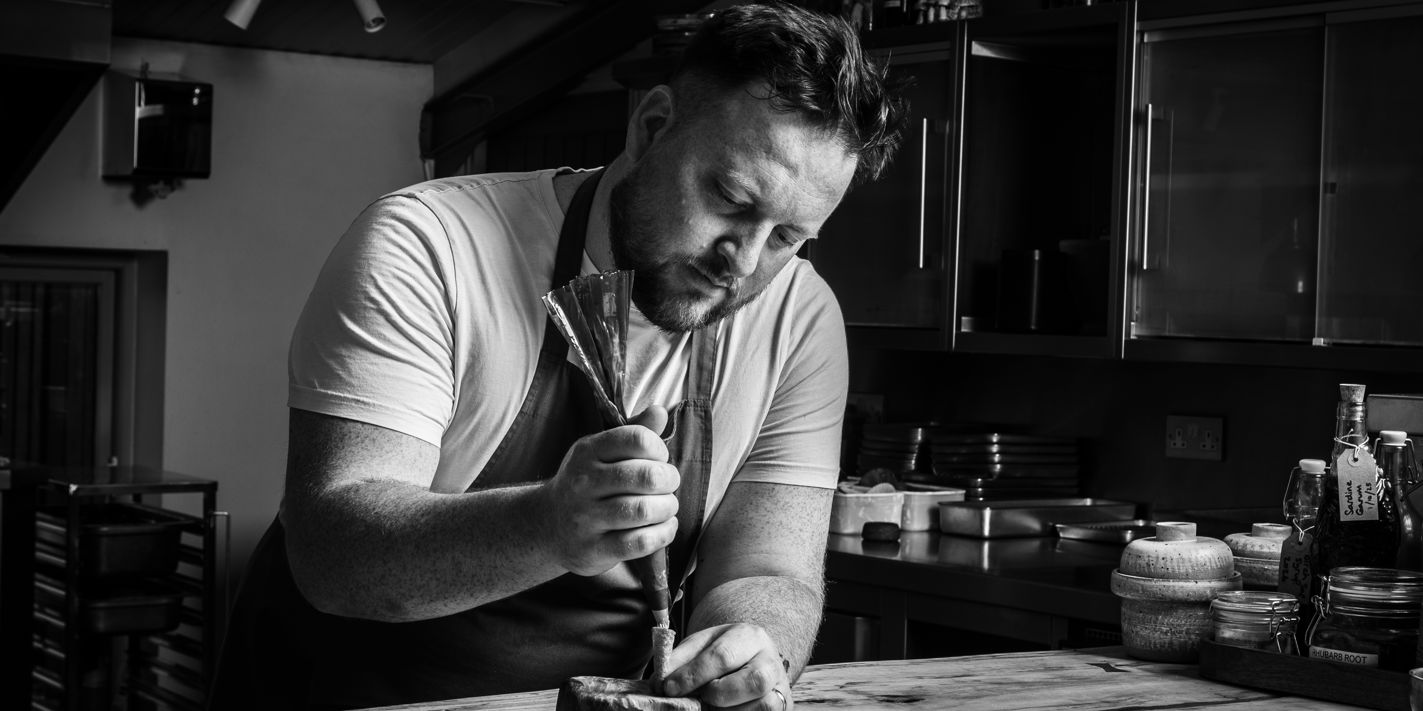
Cal Byerley
Early life and training
Cal Byerley hasn't ventured particularly far from home to open his own restaurant. Pine sits just two minutes from his family's farm at Welton Hall in Northumberland, where generations of Byerleys have worked the land since 1805. His older brother followed the family into farming, but Cal wanted to do something different and ended up going into hospitality – a decision that was basically made on his behalf. One afternoon, his father dropped him off at the Robin Hood Inn, a pub just across the road from where Pine now stands, and told him that he had a job there. Cal hadn't asked for one, but he quickly took to the independence that the job came with.
Starting as a kitchen porter, he gradually took on more responsibility. By his mid-teens, he was working in local pubs before progressing to hotels and restaurants with two and three AA rosettes. In the beginning, though, it wasn't entirely the cooking that kept him in kitchens.
‘You don't fall in love with the food you're cooking when you first become a chef,’ he says. ‘You fall in love with the camaraderie of it all and what kitchens are. It's a brigade system of people looking out for each other. It's hustle and bustle. It’s high-energy.’
His interest in cooking developed gradually, as did his understanding of the kind of chef he wanted to become. ‘I don't think I found my style in cooking for about 15 years. You learn off everyone else, deciding what you like and what sort of techniques and styles you work with best.’
Rogan & Co and Forest Side
A significant step in Cal's career came when he joined Simon Rogan's Rogan & Co in Cartmel, when Kevin Tickle was head chef. It was his first experience of a restaurant where guests travelled specifically for the food and the chefs behind it. ‘It's a really special restaurant,’ he says. ‘I mean, everything Simon does is special.’
When Kevin left to open Forest Side in Grasmere, Cal followed, taking on his first senior kitchen role. The restaurant earned a Michelin star in 2016, and Cal spent nearly five years working alongside Kevin and fellow chef Ian Waller, who would later become his business partner at Pine.
During this time, Cal developed a growing interest in the relationship between cooking and growing, building on the garden-led approach associated with Simon Rogan's restaurants and Kevin's own interpretation of it.
‘I think it's very hard to develop an individual style when you're buying the same ingredients as everyone else, from the same suppliers,’ he explains. ‘When you grow your own produce, you end up with things you simply can't buy elsewhere. Even ingredients like our kale sprouts are unique to us, because of when we planted them and when they were ready to harvest.’
After leaving Forest Side, Cal returned to Northumberland with ambitions of opening his own restaurant, while Ian moved to London. The pair would eventually reunite to create Pine.
Opening Pine
Cal and his wife Siân had been searching for the right restaurant site when she came across an old property advertisement at Vallum Farm, close to where Cal had grown up. They visited the building and peered through the windows, finding two small businesses: a trinket shop and an arts and crafts studio. The countryside views were obscured by metal cages and corrugated shelving, but they immediately saw the potential.
When the businesses vacated during the pandemic, the property became available again. Cal and Siân took on the space, converting four separate units into one restaurant.
Although Covid delayed their plans, the unexpected breathing room proved valuable. ‘Covid allowed us to take our time to learn about the place and do a lot of foraging and fermenting,’ says Cal, giving the team a head start on developing the approach to cooking that would come to define Pine.
Pine opened in 2021, with Ian Waller joining Cal in the kitchen, Siân as general manager and sommelier Vanessa Stoltz heading up the drinks programme. The restaurant's design was just as important to them as the food, with an open kitchen allowing chefs to serve dishes directly to guests and create a more personal dining experience.
‘We always wanted an open restaurant where the chefs could serve the food themselves and have that personal connection with diners. We can talk to guests, they can get to know us, and we're right there in the room with them.’
In the 2022 Michelin Guide, nine months after opening, Pine received both a Michelin star and a Michelin Green star, recognising its cooking and commitment to sustainability. Despite Michelin (controversially) putting an end to all Green stars at the start of 2026, Cal and Ian’s sustainable approach remains core to everything they do.
Growing and cooking at Pine
Since opening, Pine has doubled the size of its kitchen garden and tripled its team. Much of what appears on the menu is grown on-site or foraged from the surrounding Northumberland countryside, with Cal and Ian using fermentation, ageing and preservation to make the most of every ingredient.
‘We've just been building for five years now,’ Cal explains. ‘There's still stuff that we've got from the opening year; very old misos and garums and aged sauces.’
The same curiosity and experimentation extends to the dining itself. Cal wants guests to discover ingredients and techniques they may never have encountered before, without losing the enjoyment of a celebratory meal.
‘We're always looking for new and interesting things. As a diner, you want to learn something,’ he says. ‘Of course, people come here to enjoy a meal or celebrate an occasion, but there's something exciting about being surprised along the way. We try to include something in every course that makes people think, "What on earth is that?". I think that's part of what makes Pine special.’
Great British Menu and charity work
Outside of his work at Pine, Cal has appeared on Great British Menu three times, embracing the opportunity to cook outside the parameters of Pine's usual menus.
‘Great British Menu is so individual. You are there by yourself, and you've got no one else to lean on. It makes you think outside the box of what you are capable of as a chef. The dishes I do there I'd never do here!’
Away from the restaurant, Cal and Siân are involved in organising BiteBack, a charity food festival founded by Siân that brings together leading chefs from across the UK to raise money for Cancer Research UK.
Held at Wylam Brewery in Newcastle, the annual event sees around 20 chefs create street food dishes for guests. Following its third edition in July 2026, the festival had raised almost £330,000 for the charity.
‘To bring all these chefs that we know and admire to the North East and do something in our city is really cool for us,’ says Cal. ‘We get to bring them to this beautiful part of the world and for such a great cause.’