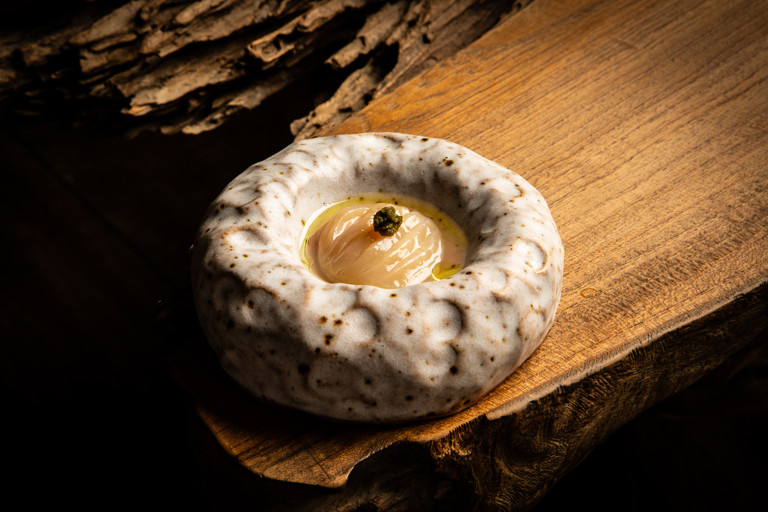
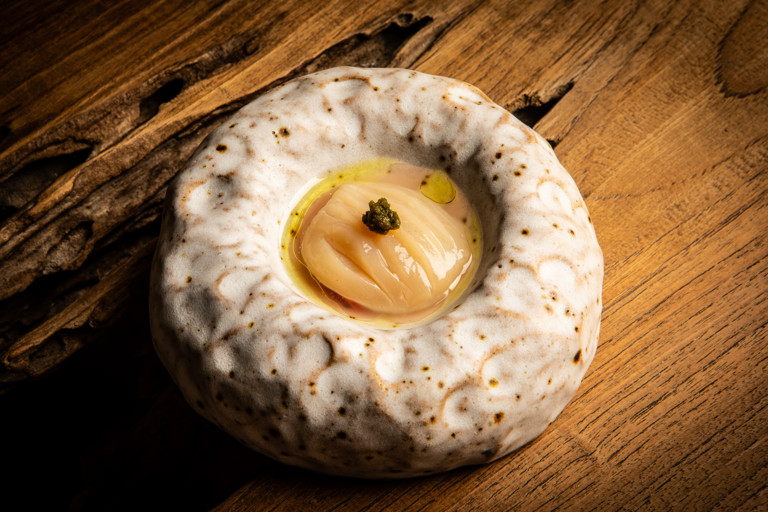
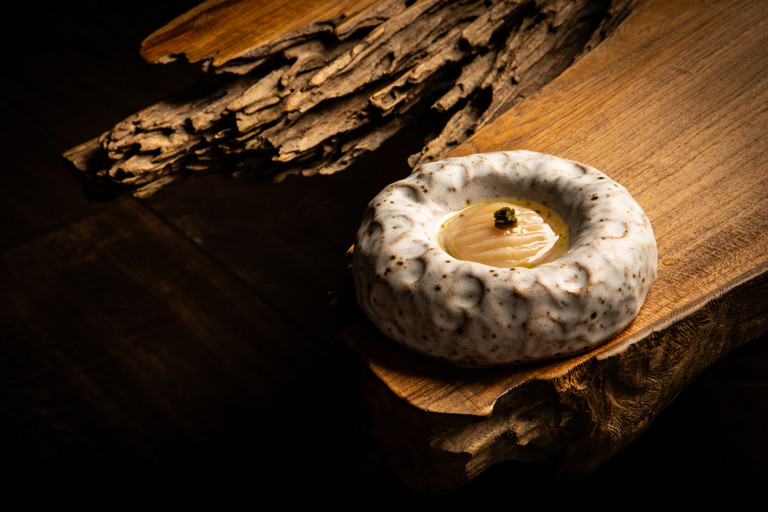
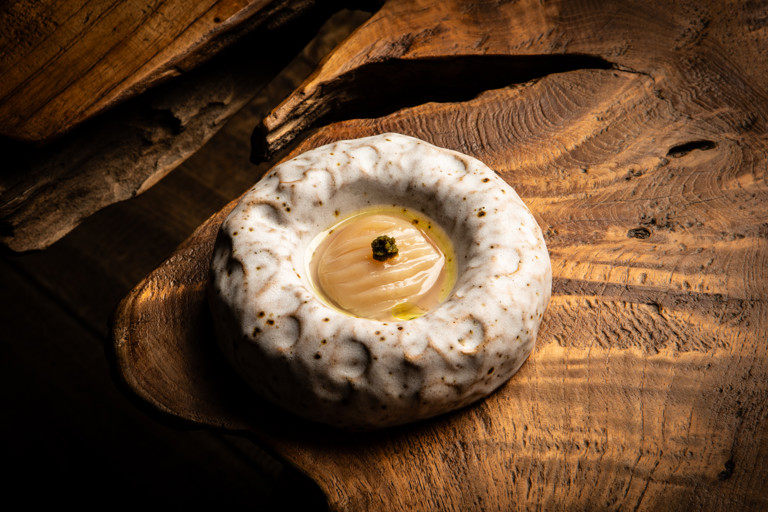
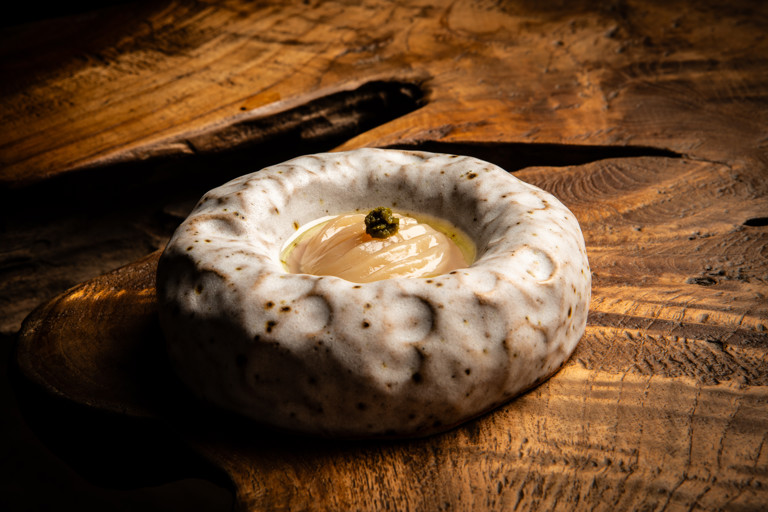
Scallop with rose koshō, rhubarb and sourdough starter crumb
- 12
- 2 hours 40 minutes plus 3 weeks fermenting time, 12 hours dehydrating time, 5 days infusing time, 48 hours slow-cooking time and overnight hanging time
Rose and rhubarb are the supporting flavours for this raw scallop dish that is lightly cured in a scallop roe salt and oil made in-house at Pine restaurant in Northumberland. The rose koshō that is delicately served on top of the dish is inspired by yuzu koshō, a fermented Japanese condiment made from togarashi chilli peppers and salt. Cal Byerley's version is made with jalapeños, white beach rose petals and their beach rose miso. The dish has a delicate and intriguing floral acidity.
If you don’t have the capacity to slow-cook the yoghurt, you can hang some shop-bought yoghurt in the fridge then mix through some ground juniper.
Ingredients
Metric
Imperial
- 6 medium hand dived scallops, cut in half horizontally and the cut side lightly scored (½ a scallop per portion)
RHUBARB & ROSE GERANIUM JUICE
- 20g of salt
- 1kg rhubarb, roughly chopped
- 100g of rose geranium flowers
SALTED ROSE GERANIUM STEMS
- 200g rose geranium stems
- salt, for fermenting
ROSE KOSHŌ
- 500g of jalapeños, deseeded
- 200g of white beach rose petals
- 10g beach rose miso, (optional)
- 45g of salt
SCALLOP ROE SALT
- 100g of flaky sea salt
- 50g of dried smoked scallop roe
- 100g of water
SCALLOP ROE OIL
- 100g of grapeseed oil
JUNIPER YOGHURT
- 300g of whole milk
- 500ml of double cream
- 2g of juniper berries, crushed
- 63g of live yoghurt
SOURDOUGH CRUMB
- 125g of unsalted butter
- 50g of sourdough starter
SALTED RHUBARB
- 15g of salt
- 250g of forced rhubarb, cut into large batons (thin stalks are best for this)
Equipment
- Dehydrator
- Sterilised jars
- Thermomix
- Squeezy bottles
- Piping bags
- Vacuum bag and machine
Method
Start the rhubarb and rose geranium juice at least 2 weeks before you want to serve the dish. Place the salt, rhubarb and rose geranium flowers in a sterilised jar and leave to ferment for 2 weeks, burping daily
- 20g of salt
- 1kg rhubarb, roughly chopped
- 100g of rose geranium flowers
Place the contents of the fermented rhubarb into a blender and blend until smooth. Freeze until solid, then defrost through a muslin cloth lined sieve set over a bowl. Reserve the juice (this will make more than you need)
For the rose koshō, first ferment some rose geranium stems. Prepare like the fermented rhubarb juice in step 1, then once pleasantly fermented (taste it every day), weigh out 150g and finely chop
- 200g rose geranium stems
- salt, for fermenting
For the rose koshō, place all of the ingredients along with the 150g salted rose geranium stems in a pestle and mortar and grind until smooth. Place in a vacuum bag, seal under full vacuum and ferment at room temperature for 2 weeks (you can ferment in a sterilised jar like the rhubarb and rose geranium juice if you prefer, burping daily)
- 500g of jalapeños, deseeded
- 200g of white beach rose petals
- 10g beach rose miso, (optional)
- 45g of salt
Store the rose koshō in the freezer until needed (this will make more than you need)
Start the scallop roe salt at least 6 days before you want to serve the dish. Blend all the ingredients together until smooth then place in a dehydrator until salt crystals reform and it is completely dry – at a low temperature this can take up to 12 hours. Weigh out 50g for the oil (this will make more than you need)
- 100g of flaky sea salt
- 50g of dried smoked scallop roe
- 100g of water
For the scallop roe oil, place the grapeseed oil and 50g of the scallop roe salt in a Thermomix and blitz until it reaches 85°C. Steep for 5 days, then strain through a muslin cloth into a bowl. Transfer to a squeezy bottle and set aside (this will make more than you need)
- 100g of grapeseed oil
For the juniper yoghurt, place the milk and cream in a saucepan and bring to 90°C over a medium heat. Add the juniper, cover the surface with cling film to stop it forming a skin and set aside to cool
- 300g of whole milk
- 500ml of double cream
- 2g of juniper berries, crushed
Preheat the oven to 40°C. Add the yoghurt and strain through a sieve into a bowl. Place in an ovenproof dish and cook for 48 hours, then set aside to cool
- 63g of live yoghurt
Place a few layers of kitchen paper in a sieve, pour in the yoghurt and place over a bowl. Hang the yoghurt in the fridge overnight until the whey has drained and the yoghurt is thick. Transfer into a piping bag and keep in the fridge until needed (this will make more than you need)
For the sourdough starter, melt the butter in a pan and, once it starts to foam, add in the starter and whisk well to break it up. Continue stirring gently until it browns and goes crispy. Strain through a sieve over a heatproof bowl. Season the crumb, to taste (this will make more than you need)
- 125g of unsalted butter
- 50g of sourdough starter
For the salted rhubarb, massage the salt into the rhubarb then place in a vacuum bag, seal under full vacuum and store in the fridge (this will make more than you need)
- 15g of salt
- 250g of forced rhubarb, cut into large batons (thin stalks are best for this)
When you’re ready to serve, prepare the scallops. Place the scallop halves cut-side face down on a tray and season with the scallop roe oil and the scallop roe salt, making sure the presentation side (the cut-side) on the tray doesn't get any marks
- 6 medium hand dived scallops, cut in half horizontally and the cut side lightly scored (½ a scallop per portion)
Slice some of the salted rhubarb into little chunks
To serve, pipe the yoghurt in the bottom of a bowl and top with pieces of salted rhubarb and sourdough crumb. Carefully flip the scallop over onto the crumb. Top with the rhubarb juice, some scallop roe oil and a tiny amount of the rose koshō
Born and raised on a Northumberland farm, Cal Byerley trained under Simon Rogan and Kevin Tickle before returning home to open Pine with his wife Siân alongside fellow chef Ian Waller and sommelier Vanessa Stoltz. Combining home-grown produce, foraging and inventive preservation techniques, the restaurant earned a Michelin star within its first year.
Get in touch
Please sign in or register to send a comment to Great British Chefs.