
Ben Tunnicliffe
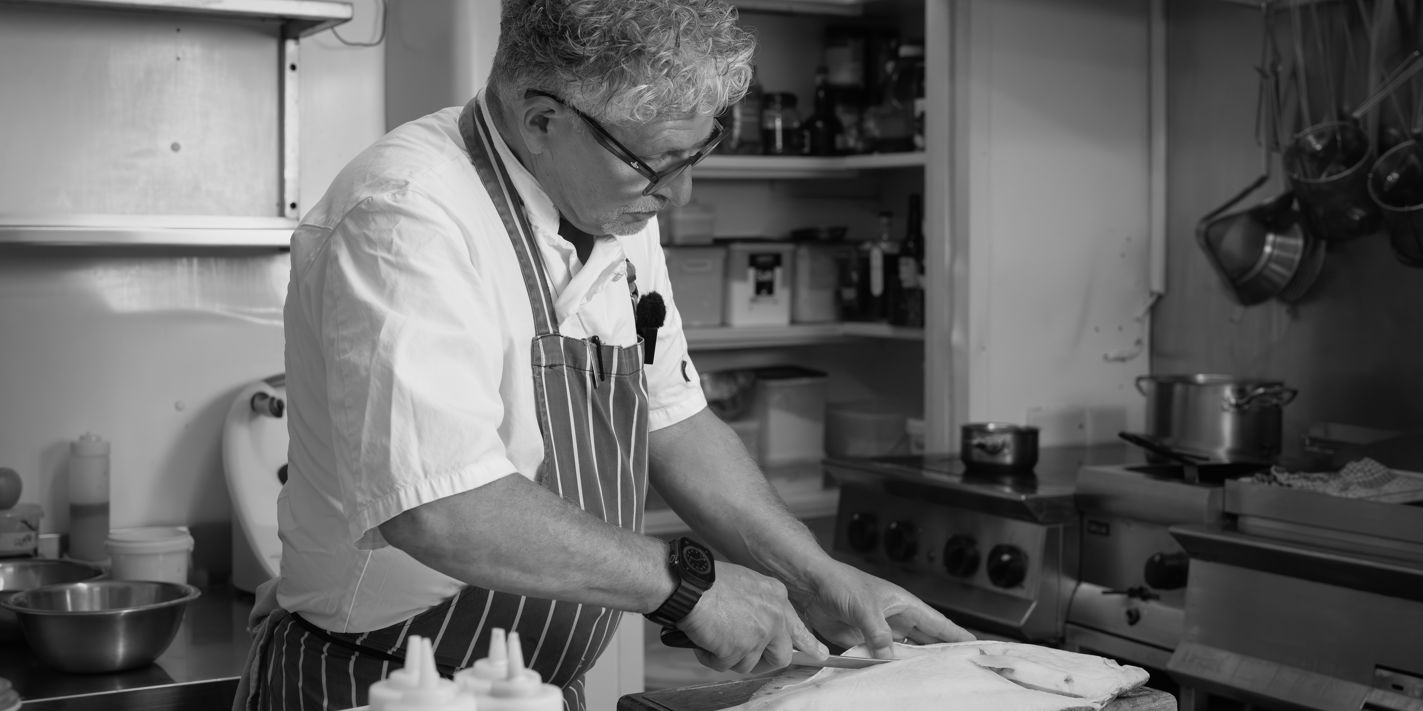
Ben Tunnicliffe
Cornwall’s fish and seafood is well-known for a reason – it’s some of the best in the world. For chefs who manage to get their hands on it, the real trick is knowing how to elevate it without overcomplicating things. Chef Ben Tunnicliffe has decades of experience doing just that.
Growing up in Bournemouth, Ben came from a large family where food was important but rarely focused on. School wasn’t the right fit and, after leaving without any qualifications, he was steered towards the city’s catering college after showing promise in home economics. Suddenly, something clicked, and Ben felt he’d found his calling.
As part of his course, Ben was sent to southwest France on a work placement, to work at chef Michel Trama’s two-Michelin-starred restaurant L’Aubergade. This was only six months after enrolling, and was a no-holds-barred taste of what it was like to work in a fine dining kitchen. ‘I was peeling garlic and shallots by the bucketload, getting shouted at in a language I didn’t speak,’ he says. ‘But it was an amazing experience. It was my first taste of just how seriously other countries took their food, which was quite different to what I’d seen back home.’
On his return to the UK, Ben spent the first decade of his career in country house hotels, leaning into the classical cookery his course and time in France had taught him. But it was working under chef Colin White at Woolley Grange in Wiltshire which instilled a real passion for sourcing. Menus were based on what the hotel’s three-acre walled garden could provide, rather than writing a menu and then ordering whatever was needed from elsewhere. Ingredient-led cooking is a given these days, but in the mid-90s it was relatively obscure. This had a profound impact on how Ben liked to cook, and to this day he can’t imagine working somewhere which doesn’t have a direct connection with the ingredients it uses.
Eventually, Ben found himself moving down to Cornwall, after a friend from his college days introduced him to the 1960s supermodel Jean Shrimpton, who owned The Abbey Hotel in Penzance. She was looking to open a restaurant next door, and Ben and his wife Kinga took it on in 2001. Two years later, it won a Michelin star (which surprised Ben more than anyone else) thanks to its approach to taking incredible ingredients, cooking them simply but rooted in classical technique, and – perhaps refreshingly at the time – doing away with the pomp of fine dining as much as a fine dining restaurant would allow you to.
‘It was an eight-year adventure where I moved to Cornwall, opened my own restaurant, my two sons were born and then I won a Michelin star,’ says Ben. He eventually sold the business in 2008, but his love of Cornwall and its larder was unshakeable, so his next move was just a few miles away at The Scarlet, an ambitious eco-hotel built into the cliffs at Mawgan Porth.
‘The Scarlet was a great experience and the place was so forward-thinking for the time,’ says Ben. ‘But I didn’t like all the KPIs and the meetings and all the talking we had to do; I wanted to be in the kitchen, cooking.’ It was clear he needed to work for himself and find a place to call his own once more.
That place turned out to be a small pub in the fishing port of Newlyn. Despite being a major harbour town, Newlyn itself had no restaurants which focused on fresh fish and seafood at the time. Ben saw an opportunity, and The Tolcarne Inn opened in July 2012, with a blackboard menu which changed daily depending on what was landed literally a few steps away.
Over a decade later, The Tolcarne Inn continues that same ethos. Mornings begin with Ben talking to his fish merchant, then basing the menu around what’s available. That approach goes beyond the harbour – fruit and veg come from small, local growers, too. ‘If you take the time to source ingredients, then cook them from the heart and show them the respect they deserve, that’s all you need to do as a chef,’ he says. The food might sound simple on the menu and appear minimalist on the plate, but the technique and skill in The Tolcarne’s small kitchen (often staffed by just Ben and one or two other chefs) is apparent in every bite. This is cooking for the love of cooking, rather than anything ego-driven; the fact that it’s done using some of the best ingredients in the world is what makes it worth travelling for.