
Weckmänner (dough men)
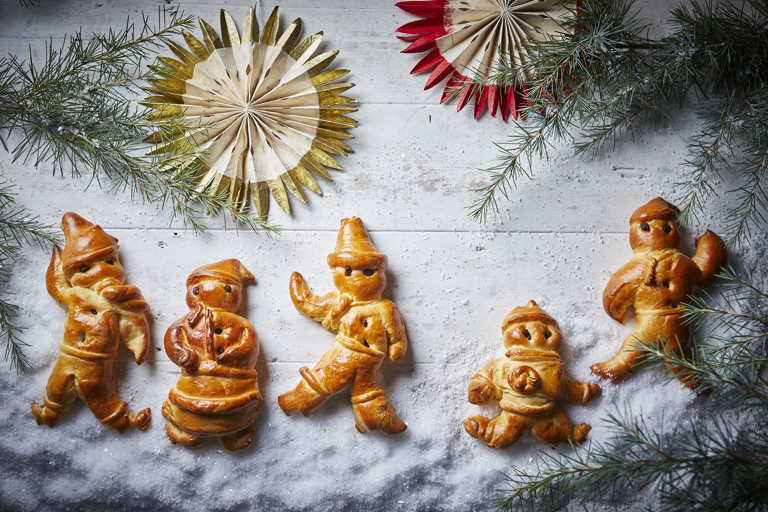
Outside of Germany, these are perhaps not the most well known Christmas treats, but within Germany they are a nostalgic childhood favourite. Sure to be loved by kids, these are a great festive alternative to gingerbread men. This recipe is taken from The German Christmas Cookbook by Jürgen Krauss (£26, Octopus Publishing Group). Photography by Maja Smend.
Jurgen says: "These sweet breads shaped like little men are traditional in many parts of the German-speaking world, where they are known under a variety of names – Weckmann, Nikolaus-Mann, Stutenkerl and Grittibänz, to name just a few. They are often made around St Martin’s Day (11 November) or St Nicholas Day (6 December), and during the Advent period. In our village, all the children participating in the lantern procession on St Martin’s Day were given one of these dough men. If you give them to your German or Swiss friends, you will certainly conjure up some childhood memories for them!"
Ingredients
Metric
Imperial
- 60g of unsalted butter, cubed, at room temperature
- 250ml of full-fat milk, lukewarm
- 500g of strong white flour, plus extra for dusting
- 60g of caster sugar
- 2g of salt, plus an extra pinch for the egg wash
- 7g of fast-action dried yeast
- 1 egg
- raisins, as needed
Method
If the butter is too cold, add it to the milk and microwave or heat gently on the hob until the mixture is lukewarm
- 60g of unsalted butter, cubed, at room temperature
- 250ml of full-fat milk, lukewarm
Put all the dry ingredients into a bowl and whisk to combine. Add the butter, milk and egg and mix well. Using your hands or an electric mixer fitted with a dough hook, knead the dough until it loses its stickiness and forms a smooth ball
Cover with clingfilm and set aside in a warm place for at least 1 hour, until the dough is well risen and puffy, with lots of air bubbles. Many baking recipes mention that the dough should ‘double in size’ – this is a somewhat unclear instruction, as the doubling could refer to the volume, or simply to the appearance of the dough, and those criteria are hard to measure
Line 2 baking trays with baking paper and set them aside
Divide the dough into 150g pieces. Set aside one piece, then roll the others into balls
On a lightly floured surface (just enough to avoid sticking), use your hands to roll each ball into a plump log
The next step is to create the head and body shape. With palms down, turn one hand at right angles to the other hand, with the little finger being near the work surface
Place the edge of your rotated hand near one end of a log and the other hand near the other end. Continue the rolling movement with both hands so that you end up with a skittle shape – a small head on a tapered body. Make 4 more bodies in the same way, then cover with a tea towel or plastic bag and leave to rest for a few minutes
Flatten each body using a rolling pin or your hands, making sure the shoulders are the widest part, about 4cm wide, and that the lower end remains quite pointy. The length of the whole piece should by now be around 20cm
Use a sharp knife or dough cutter to cut the arms, from the imagined hip up towards the shoulder, parallel to the spine. To form the legs, cut the lower body apart, from the pointed end to about halfway up the figure, where the arms start. Transfer to a prepared sheet and shape the arms and legs as you wish
To form the feet, cut halfway through the inside end of each dough leg, then turn the tips sideways
To decorate, roll out the reserved dough ball thinly, about 1mm thick. Use a knife to cut about 10 strips of dough about 2mm wide and 10cm long, and 5 triangles with 4cm sides
Take a triangle and wrap it around the top half of the head to create a pointed hat. Use the strips to create a belt, and a scarf that you wrap around the neck and twist at the front. You can also use shorter strips to wrap around the legs, about 3cm above the feet; this creates the effect of boots
Finally, push some raisins into the dough for eyes and buttons
- raisins, as needed
Cover the figures and set aside to rest in a warm place for about 40 minutes
Preheat the oven to 170°C fan/gas mark 5
Check the raisins on your figures – if they have risen to the top, push them back into the dough. Brush the egg wash onto your figures, then bake for about 15 minutes, until deep golden
These are best eaten fresh, but can also be toasted for a great addition to the breakfast table. If stored in an airtight container, they will keep for 3 days
Jürgen Krauss was the star of Bake Off 2021, his semi-finals departure triggering over 100 complaints from dismayed viewers. His love for baking began during his childhood in the Black Forest. His travels across Europe, before settling in Brighton, UK, widened his culinary influences, but also gave him the yearning to master German bread-making, the perfect showcase for both his technical precision and creative flavours.
Get in touch
Please sign in or register to send a comment to Great British Chefs.