How to boil an egg
20 November 2026

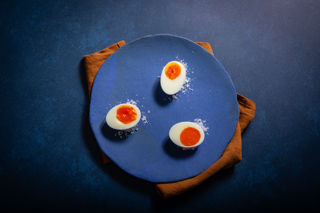
Boiling an egg feels like one of the simplest things you can do in the kitchen – but like any technique, the devil is in the details. Eggs are a very unique ingredient in that their texture can be completely transformed and altered depending on all sorts of variables. And while boiling is often seen as the most foolproof way to cook an egg – as you have the protection of its shell and no risk of burning it – little tweaks and changes to what you do can have a real impact. Here’s how we break down the method and what we do at GBC to ensure our eggs are boiled to perfection every time.
It’s happened to us all – you drop your eggs into boiling water and the shell instantly cracks, releasing a ghostly white and waterlogging the egg within. It usually happens for two reasons, both of which are easily avoided.
First of all, be gentle! Pans are hard and eggs are fragile – if you are dropping your eggs into the water instead of gently lowering them in with a slotted spoon, that’s probably the reason why they’re cracking. It’s also a good idea to keep your water at a steady simmer rather than a vigorous boil, as anything too lively can bounce the eggs around a little too much and cause cracks as well.
But even a carefully lowered egg can still crack in boiling water. It’s all down to thermal shock – the sudden difference in temperature when the egg is submerged in boiling water can cause a pressure build-up strong enough to rupture the shell. The solution? While you’re waiting for your water to boil, submerge your eggs in hot water from the tap. This raises their temperature enough to ensure the thermal shock isn’t strong enough to cause a crack. This is especially important if you keep your eggs in the fridge.
This is the million dollar question for any egg boiler. The short answer? Five-and-a-half minutes, starting as soon as your (warmed in hot water) egg is lowered into boiling water. That’ll give you a perfectly set white and a yolk that’s runny with just a hint of jammy fudginess.
The long answer? It depends on how you like your eggs and what you’re using them for. Assuming your egg is warmed in hot water before it’s boiled, this is the chart we’d use:
5 minutes: a soft-boiled dippy egg
5.5 minutes: a soft-boiled egg with a runny-yet-thickened yolk
6 minutes: a boiled egg with a jammy yolk
6.5 minutes: a hard-boiled egg with a firm yet soft yolk
7+ minutes: a hard-boiled egg with a firm chalky yolk
As soon as your chosen time is up, lift your eggs out of the boiling water and ideally submerge them in a bowl of iced water. If you don’t have ice to hand, you can run them under the cold tap for a few minutes too. Either way, the key here is to cool the egg down quickly so it halts the cooking process. Doing this also avoids the dreaded ‘grey ring’ – an unappetising (yet perfectly safe to eat) ring of discolouration around the yolk which appears when the egg overcooks and lets the sulphur in the white react with the iron in the yolk.
Even if you want to serve your boiled egg warm, you need to wait until it’s cool enough to handle so you can peel it. Getting to this stage as quickly as possible via iced or cold water is still recommended, as it ensures your egg won’t continue to cook while you wait.
After cooling (either completely or until cool enough to handle), it’s time to peel. The trick here is to break through the thin membrane that exists between shell and egg white. Boiling then rapidly cooling the egg will help naturally release the membrane from the white, so after a few firm taps on the counter and breaking through the shell, try to peel away a piece of the membrane too. That will then help you easily peel the egg (and remove the membrane at the same time) whilst leaving the white perfectly intact. Your beautifully boiled egg is now ready to eat!
Put a saucepan of water on to boil. Submerge your egg(s) in a bowl of hot water from the tap. Set up a separate bowl of iced water
Once your water is boiling, lower the heat to a strong simmer. Gently lower your egg(s) in using a slotted spoon. Instantly set your timer for the desired amount of time
When the timer is up, lift your eggs out of the water and immediately submerge them into the iced water. If you don’t have iced water, put them in a bowl and run them under the cold tap for a minute or so
Tap the egg on your counter to break the shell. Peel away the broken piece, trying to remove the membrane as well. Finish peeling the egg, then briefly dip it in cold water to remove any fragments of shell that remain
Now you have your perfectly boiled eggs, here are some of our favourite dishes which put them centre stage.
Japanese sandwiches are known for being extra soft and fluffy, with very fine, rich eggy filling. We’ve made ours with an extra Freshlay Farms Golden Yolker® in the centre for even more yolky goodness.
Please sign in or register to send a comment to Great British Chefs.