What to eat, drink and do in Lublin, Poland
by Great British Chefs13 July 2026

The majority of Poland’s tourists head to Kraków or Warsaw. Some might visit Gdańsk or Wrocław; those who love nature may even check out the Tatra Mountains or Masurian Lake District. More and more of those in the know, however, are heading east to the city of Lublin. We can see why.
There’s the beautiful Old Town, streets steeped in history and stunning countryside around the outskirts. It’s becoming Europe’s Capital of Culture in 2029, so there’s a buzz of excitement everywhere you go. But of course, we were there for the food – and Lublin certainly didn’t disappoint.
This part of Poland boasts more region-specific dishes than anywhere else, often shaped by its Jewish heritage and agricultural traditions. It’s also enjoying a resurgence of artisanal producers and passionate chefs, who are transforming the dining scene into somewhere worth shouting about. If you’re the kind of person who loves discovering new flavours and beautiful places off the beaten track, Lublin should be at the top of your list – and once you get there, here’s what you can expect.
In Poland, you tend to get two types of bakery: piekarnia, which focus on breads and daily baked goods, and cukiernia, which are more like French patisseries and offer cakes and confectionery. We visited three which are worth seeking out.
If there is one dish that truly represents Lublin, it’s the cebularz (pronounced seh-boo-lash). Rooted in the Ashkenazi Polish Jewish community, this flatbread topped with onions and poppy seeds may sound simple, but it is far more delicious than the sum of its parts. They are found in every bakery and restaurant across Lublin (and enjoy PGI-protected status from the EU), but the best place to get them is Piekarnia Kuźmiuk, which is the oldest artisanal bakery in Lublin and has been producing them since 1944.
The humble goat is the spirit animal of Lublin, ever since it appeared on the city’s coat of arms way back in the 14th century. Little goat statues can be found dotted around the streets, and at Cukiernia Chmielewski, the city’s oldest and most famous bakery, you’ll find a goat-horn-shaped treat that’s become an emblem of the local food scene. Kozi Róg are delicious little handheld choux pastries filled with cream and topped with chocolate and hazelnuts; they’re the perfect thing to snack on as you walk Lublin’s beautiful streets.
Lublin does traditional bakes very well – but there are more modern bakeries lining its streets too. One of the standouts is the compact Na2 Piekarnia, which offers a range of freshly baked loaves, great coffee, beautiful flatbreads and handmade granolas. It’s the perfect spot to pick up a few treats if you’re self-catering in the city.
Before the Second World War, Lublin was an epicentre of Jewish culture, making up a third of the city’s population. Despite that community being completely decimated by the Nazis, the rich history and lasting legacy of Jewish food lives on at places like Mandragora. This beautiful restaurant serves classics like salt beef, chopped liver, roast goose and challah, and was a prominent location in the critically acclaimed 2024 comedy-drama A Real Pain.
Elsewhere, there’s The Olive at Hotel Ilan. Today, it’s where visitors stay and enjoy classical Jewish dishes, but this magnificent building was once the Yeshica Chachmei, the largest and most prestigious rabbinical school in the entire world. It’s an incredible slice of history and provides modern interpretations of classic Jewish dishes.
Lublin has heaps of history behind it, but that doesn’t mean everything is looking to the past. Trendy, continental cafés and brunch spots do a buzzing trade, offering modern, light and fresh dishes that take inspiration from around the world. The best we tried were Spokojna2 – just round the corner from the Na2 Piekarnia – which boasts a bright, airy dining room in front of the open kitchen, and Café Mari, a smaller, tucked away spot which focuses on great coffee, a few grab-and-go options and a tight menu of simple yet stunning hot dishes. They’re both open throughout the day and evening, too, in case you fancy a lie-in.
We ate a lot during our time in Lublin, but of everything we enjoyed, from the traditional to the modern, it was a dinner at Bibosz that really stood out. Chef Mateusz Stasikowski heads up the kitchen there and his cooking was a real cut above. His previous stints in Michelin-starred kitchens really shine through, and his ability to combine classic Polish ingredients and flavours with modern, playful and relaxed plating made every bite a joy. The restaurant is casual, with a bar and live music, but the cooking is really the draw here.
Perła is the largest independent brewery in all of Poland, most famous for its lager – which is popular across the country. Despite its huge size, it still manages to retain that artisanal, craft beer feel, and its brewery tours are a wonderful way to get to know its history (it was originally founded on the ruins of an old monastery back in 1844). Today it’s an attraction in itself, with a Perłowa brewhouse boasting the longest bar in Europe, a Michelin-recommended restaurant, apartments you can stay in, and outdoor cinemas and nightclubs during the summer months. There’s no better drink to enjoy during your time in the city.
Polish wine – much like English wine – is still in its infancy but rapidly expanding. Focusing on cooler climate grapes and small, closely monitored vineyards, only a few bottles make it out of the country – so it’s well worth tasting your way through them when you’re there. Just north of Lublin is Winnica Sienkiewicz, a true micro-vineyard which has less than one hectare of vines. Owner Mariusz Sienkiewicz turned his hobby into a business back in 2016 and has since become known for producing some of the best wines in the Lublin region. There are nine grape varieties which go into his award-winning bottles and he is truly passionate about what he does, making a trip to the estate a great day out.
Okowita is the Polish name for eau de vie, which is essentially brandy produced from fruits or, in some cases vegetables. This high-strength spirit is often misunderstood, but Dyssov Distillery in the countryside outside Lublin is leading the charge to change that. It uses its beautiful, custom-made copper still to produce incredible, award-winning okowita made from local apples, honey, hops, rye, blackcurrants and even young potatoes. The flavour of the base ingredient really comes through in the finished product, and it’s a brilliant souvenir to take home after visiting the region.
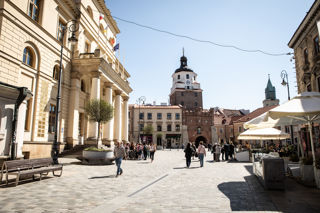
One of the biggest draws of Lublin is its stunning Old Town, overlooked by Lublin Castle, with some buildings dating back to the 13th century. Beautiful architecture can be found on every street – in any other city this area would be crowded with tourists, but Lublin still retains an undiscovered, relaxed atmosphere (although this is changing each year as more people discover it!). Shops, bars, restaurants and bakeries are dotted throughout, with various monuments, squares, gates and walls offering rich history within a single kilometre. It’s one of the most beautiful parts of Poland.
Two hours northeast of Lublin, right on the Belarusian border, you’ll find somewhere very unique. Uroczysko Zaborek has hosted the Rolling Stones, Arab sheiks and famous artists over the years, thanks to its jaw-dropping natural surroundings and peaceful, private location. It’s essentially an open-air museum you can stay in, with saunas and hot tubs dotted between historical lodges, churches and windmills which were all saved from demolition from nearby villages and towns, transported to Zaborek and rebuilt within the grounds. For food-lovers the restaurant serves incredible examples of traditional Podlaskie dishes (a mix of Polish, Lithuanian and Belarusian cuisines), including some of the best dumplings we’ve ever tried. Every building, garden, sculpture and painting has a fascinating story to tell.
Please sign in or register to send a comment to Great British Chefs.