A cut above: Tommy Banks and Jackson Boxer on the importance of good knives
by Great British Chefs18 November 2026

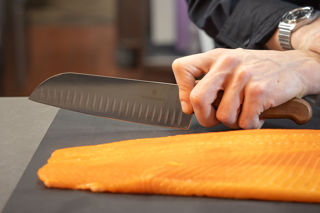
A beautifully presented restaurant dish can disguise hours of preparation. By the time it reaches the table, every ingredient has been carefully butchered, sliced, trimmed or portioned, often with precision that leaves little room for error.
For professional chefs, knife skills are about much more than making ingredients look good. The way something is cut can change its texture, influence how it cooks and ultimately determine the success of the finished dish.
To find out just how important good knives are in a professional kitchen, we asked Tommy Banks, chef-owner of The Black Swan at Oldstead, and Jackson Boxer, chef-owner of Brunswick House, to each choose one dish from their menus that would be particularly difficult to prepare without the right tools.
Their choices couldn't be more different: a complex wild mallard dish with several carefully prepared accompaniments, and a pork-and-prawn-stuffed chicken wing that demands absolute precision. However, both demonstrate just how much work happens before service even begins.
At The Black Swan in North Yorkshire, Tommy Banks' cooking is closely connected to the surrounding landscape and the ingredients it produces. His chosen dish centres on wild mallard, which is barbecued on the crown and served with finely shredded glazed red cabbage, homemade black pudding, Jerusalem artichoke bread sauce, crispy kale and a rich mallard jus. It's a dish that calls for four different knives, each with a specific purpose.
'Mallard is abundant in our part of North Yorkshire, and I think we should be making the most of ingredients like that,' says Tommy. 'It's a wonderful wild bird, but it's not something you see on restaurant menus particularly often.' Part of the reason, he explains, is that mallard can be difficult to cook well. Understanding how to butcher and present the bird is every bit as important as cooking it.
Tommy barbecues the mallard on the crown, keeping the meat on the bone to retain its juiciness while rendering the skin. But once the bird is cooked, there's still a particularly demanding stage to come. The breasts must be removed from the crown and carved into even pieces, all at the last minute.
To do this, Tommy uses a Victorinox Fibrox Boning Knife, following the bone carefully to remove each breast without tearing the flesh or damaging the skin. He then switches to a Victorinox Fibrox Carving Knife, which has a long blade and allows him to cut cleanly through the meat.
'You want to be able to do that final bit of preparation with absolute confidence, particularly when you're doing it at speed during a busy restaurant service,' he explains. 'When you've got a beautifully cooked mallard breast that's been carefully removed from the bone and carved into perfect pieces, it looks incredibly appetising,' says Tommy. 'But if you butcher or carve it badly, suddenly it becomes a much less appealing proposition!'
While the mallard might be the centrepiece, the accompaniments require just as much attention. For the glazed red cabbage, Tommy uses a Victorinox Wood Santoku Knife with a fluted blade to finely shred the leaves. The fluting helps prevent the cabbage from sticking to the blade, making it easier to achieve consistent slices.
It's not simply a question of appearance. Slicing the cabbage so finely changes the way it cooks and absorbs the glaze, resulting in a softer, more delicate texture. 'It's a great example of how something as simple as the thickness of your knife cuts can completely change the way an ingredient eats,' says Tommy.
The homemade black pudding requires another technique altogether. Served as a small boudin, it contains tiny pieces of guanciale that must be diced finely enough to distribute evenly throughout the mixture. For this, Tommy reaches for a Victorinox Wood Chef's Knife, using its sharp blade to produce a fine, consistent dice.
At Brunswick House in London, Jackson Boxer serves a dish that might sound comparatively simple, but presents a very different technical challenge: a chicken wing stuffed with pork and prawns.
Unlike Tommy's mallard, which calls for several different blades throughout preparation and service, the success of Jackson's dish rests heavily on one particularly delicate task: the chicken wing must be completely deboned while keeping the surrounding flesh and skin intact. One wrong cut and the wing is unusable.
To remove the bones, Jackson uses a Victorinox Fibrox Boning Knife, carefully working around them without piercing the flesh or breaking the skin. The process requires a sharp, precise blade, a steady hand and considerable concentration.
'If the flesh or skin gets broken while removing the bone, the wing must be discarded and can no longer be used,' Jackson explains. There's no opportunity to disguise an untidy cut or compensate for a mistake later in the cooking process. The initial knife work determines whether the wing can be used at all.
The filling brings its own demands. Jackson must carefully butcher the pork shoulder, removing the sinew before preparing the farce that will be used to stuff the wing.
While the finished dish might appear relatively straightforward, its preparation relies on a combination of butchery skills, precision and patience.
Despite the specialist techniques involved in their chosen dishes, both chefs agree that a versatile knife is one of the most valuable tools in any kitchen. For Tommy, it's the Victorinox Wood Bread and Pastry Knife. 'I honestly don't think I've ever met a chef who hasn't got one in their knife roll,' he says.
Although designed for pastry work, trimming tart cases and slicing bread, Tommy also uses it for preparing vegetables, carving beef Wellington and cutting clean slices through terrines. 'It's just one of those knives that you find yourself reaching for all the time because it does so many different jobs incredibly well.'
Jackson, meanwhile, favours the Victorinox Wood Santoku Knife, describing it as 'a fantastic all-purpose blade, perfectly suited to so many different tasks'.
Their preferences highlight an important distinction: while certain dishes require specialist blades, a good everyday knife remains the foundation of a chef's kit.
For anyone hoping to improve their knife skills at home, neither chef recommends investing in an enormous collection of expensive equipment. Tommy's advice is to start small, with a few versatile knives that are comfortable to use and properly maintained. 'A really good, medium-sized chef's knife will do an enormous amount of work in a home kitchen. Add a good Victorinox Bread and Pastry Knife, and you've probably covered the vast majority of jobs you'll ever need to do.'
He also stresses the importance of maintaining a sharp edge, using a steel regularly and learning how to sharpen knives properly when needed. 'I'd much rather have two really good, sharp knives than a drawer full of expensive blunt ones.'
For Jackson, the most important consideration is how a knife feels in your hand. 'Always select a knife that feels well balanced in your hand, and which you can wield with confidence.'
It's advice that applies equally to the intricate preparation of a Michelin-starred dish and the everyday demands of cooking at home. A good knife isn't necessarily the biggest or most expensive one in the drawer. It's the one that allows you to work cleanly, precisely, and confidently in every project.
Please sign in or register to send a comment to Great British Chefs.