
Joe Otway
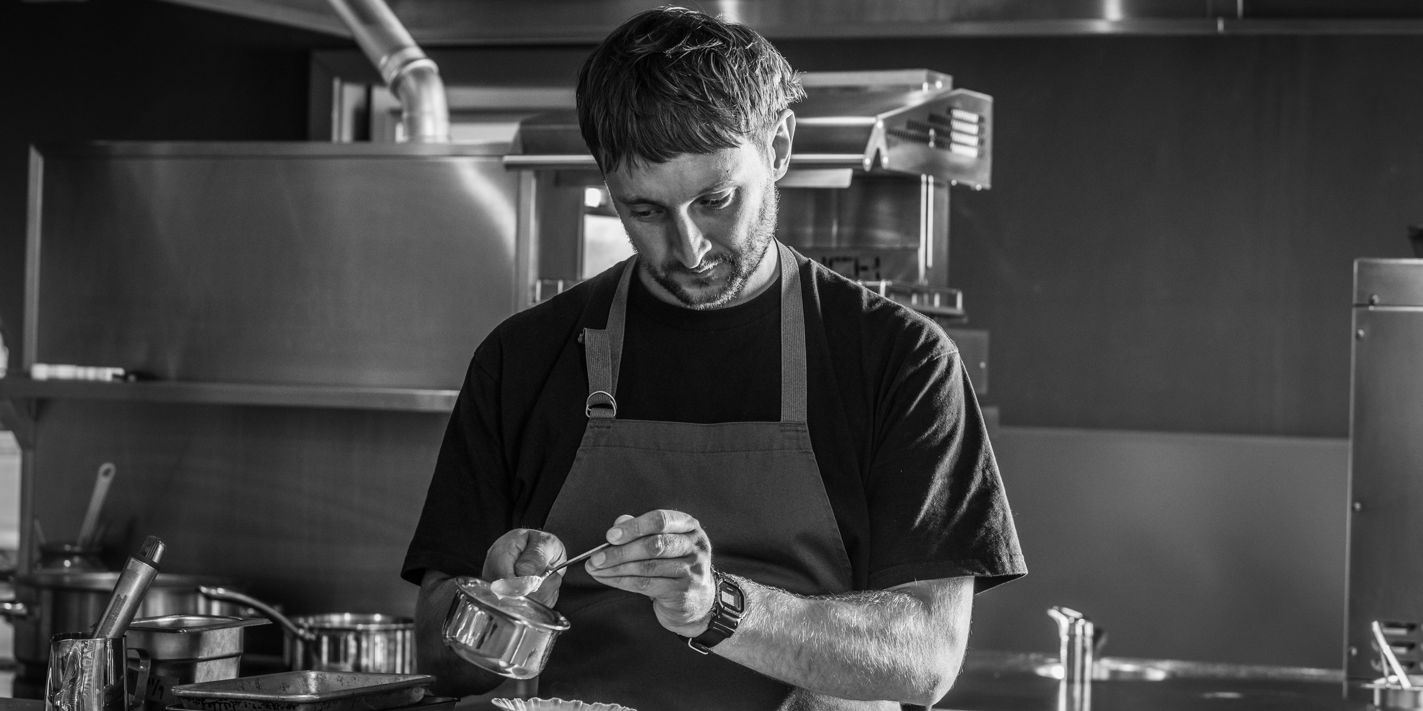
Joe Otway
Joe Otway has become one of the most influential chefs in Manchester: a city with a vibrant, constantly growing food scene which shows no signs of slowing down. His flagship restaurant Higher Ground, along with his other spaces Flawd and Bar Shrimp, share a contemporary thoughtfulness; together they question how and why the so-called ‘norms’ of hospitality exist, creating gently unique spaces which capture guests’ imaginations.
At Bar Shrimp, a carefully curated cocktail list sits alongside an accessible seafood menu while local DJs spin records. At Flawd, natural wine is demystified with careful curation as seasonal little plates of delight are sent out of a small kitchen space. But it’s at Higher Ground that Joe Otway’s food, cookery and overall ethos are best demonstrated.
Joe might be known for cooking some of the most interesting and delicious food in Manchester today, but that interest in flavour and gastronomy simply didn’t exist during his childhood. ‘I didn’t really have any interest in food at all!’ he says. ‘I didn’t eat much and I don’t have any early memories of eating great food from my childhood.’ Growing up in Brighton, it wasn’t until Joe found a creative spark in his home economics GCSE course that he found the world of food even remotely interesting.
At that point, he’d caught the bug and so, after his studies, Joe enrolled in a City and Guilds course with a weekend job as a waiter in the then-famous Aldo Zilli restaurant in Brighton. A chef in the brigade caught on that Joe would soon leave the restaurant for a cookery course, and so invited him into the kitchen. The age of 18 might sound young, but for many chefs who had worked in restaurants since they were 15 (or younger) – or had a strong passion for food passed down to them – Joe was something of a late bloomer.
After working in a small Brighton hotel he joined chef Dave Mothersill at the Ginger Pig near Brighton, before being offered, aged 20, a position in South Africa thanks to a chef he'd worked for at Aldo Zilli, who was opening a modern Italian restaurant in Cape Town. ‘There’s a chef out there,’ – Joe points towards the chefs working away in the large open kitchen at Higher Ground – ‘called Chris. He and I went out to Cape Town together. It was a fucking crazy place. The company was essentially owned by this travelling circus and back in 2011 the city wasn’t as developed. Everything from the roads to the technology felt really minimal, but it was great.’ Joe and Chris went initially for three months – working without a single day off for that whole period – but after the reality that Joe would need to return to the UK set in, the company sorted his visas and paperwork and Joe stayed out there for two more years.
Running a high-pressure restaurant as a 20-something in a foreign city is a real education. ‘We were running this kitchen with a different level of skill than what we were used to in England,’ Joe notes. ‘You very quickly learn a lot about yourself.’ It’s clear that this time in Cape Town was where Joe truly cut his teeth: elevated at such a young age to the position of sous chef, he learned how to be both a manager and leader while developing his own culinary skills at the same time.
After these intense years in South Africa, Joe decided it was time to move on and organised himself a two-month stage at the three-Michelin-starred restaurant Benu in San Francisco. ‘I wanted to be in a kitchen that was going to really push me and teach me more technical skills. My eyes were opened to this whole other world of fine dining.’
After hearing his old head chef and friend David Mothersill was planning to open a new seafood-focused restaurant named The Salt Room, Joe returned to the UK to work alongside him. Delays in the opening meant he had a few months to kill, so Joe took the somewhat unexpected turn to spend six months working as a chef at the modern Indian restaurant Chilli Pickle. ‘It was a different planet,’ he says. ‘Nothing was like anything I’d done before. Everything was so old school and I was the only British chef working there. I was working six days a week but I loved it; I wanted to push myself and learn more.’
A common thread throughout Joe’s career is his unrelenting work ethic and hunger for knowledge. Whether it's South Africa, San Francisco or Brighton, there is always a six-day work week waiting for him to understand more about the vast and complex world of food and cooking. While this steely fortitude helped him to grow and develop quickly, sacrificing his free time is something Joe is highly conscious of now as a restaurateur. In short: his teams get their time off.
Eventually, Salt Room opened and Joe rejoined Mothersill, before discovering the seminal book of the acclaimed chef and restaurateur Dan Barber: The Third Plate. This moment would prove to be a catalyst and a turning point for Joe. ‘Once you’ve read it, you can’t forget it,’ he notes.
At the time, to ensure the finest produce, the Salt Room was going through two fish deliveries a day, and the constant back and forth with the fishermen made Joe realise that he wanted to learn more about Dan Barber's sustainable approach to sourcing. ‘I reached out to Dan at his restaurant Blue Hill at Stone Barns, and managed to get a job there. I said something along the lines of ‘I’ve read your book and it’s changed the way I think about the way I work. I’m not moving to New York to be in New York; I’m moving to New York to work for you’.’ It worked.
Joe started working at Blue Hill soon after, and it instantly influenced his outlook. The restaurant is a huge education for even the most skilled chefs and is still regarded by many in the industry as one of the very best restaurants in the world. And while the demands around the chefs working there were incredibly high, the respect they received was paramount.
‘No one would ever swear,’ says Joe. ‘Everyone said please and thank you; no one raised their voice really. It was just so respectful. One day I hurt my foot, and another chef got wind of it. Almost immediately, I was told I was going to see a specialist at a local hospital. I was used to almost cutting off a finger and cracking on with service, but this culture they created was so different.’
Joining Dan Barber in London for the 2017 WastEd project at Selfridges – a food waste initiative run by the department store to bring chefs from around the world to share ideologies about how to reduce waste – Joe met Christian Puglisi. This meeting would prove fortuitous as after Joe’s 12 months at Blue Hill were up, he decided to yet again expand his learning with stages across Europe. One of these stages was at Christian’s three-starred restaurant Relæ in Copenhagen, where he ended up getting a permanent role.
‘It was just an incredible place,’ he says. ‘Christian changed the game and changed the formula, and that's something we’ve really tried to do here; change how restaurants work and how people eat. Blue Hill changed my philosophy but Relæ changed how I cooked’.
Joe was working at Relæ for years until Sam Buckley, the founder of Stockport restaurant Where The Light Gets In got in touch. After a job interview (at noma, no less!) Joe returned to the UK to head up the WTLGI kitchen for a little over a year. During this time, Joe was exploring opening his own restaurant. After a site in Brooklyn, New York, fell through, he and his business partners looked locally and decided that Manchester could be the perfect location for their inaugural project.
Higher Ground began as a pop up in 2019, with a farm opening in 2020 which has now evolved into the expansive Cinderwood Market Garden. Sadly the Covid pandemic shuttered the initial Higher Ground concept, yet with the Flawd wine bar opening in 2021, the green shoots of those ideas remained. Higher Ground would go on to find its permanent site in 2022 – a testament to the will of the founders and their dedication to their ideas.
It’s clear the farm is the central driving force behind everything that Joe’s restaurants offer. ‘If I’m going to cook what I want to cook, I need to get my hands on the best produce possible,’ he says. Cooking with exceptional produce and a positive and healthy crew is something that’s clearly front and centre of Joe’s mind. Staff turnover is low and the benefit of accessing the farm creates a culture of heightened engagement in the work. Joe works hard to make sure his team have consecutive days off: it’s obvious to see that the mini empire Joe and the wider team are building is one of the best places to work in the city.