
Eugene Korolev
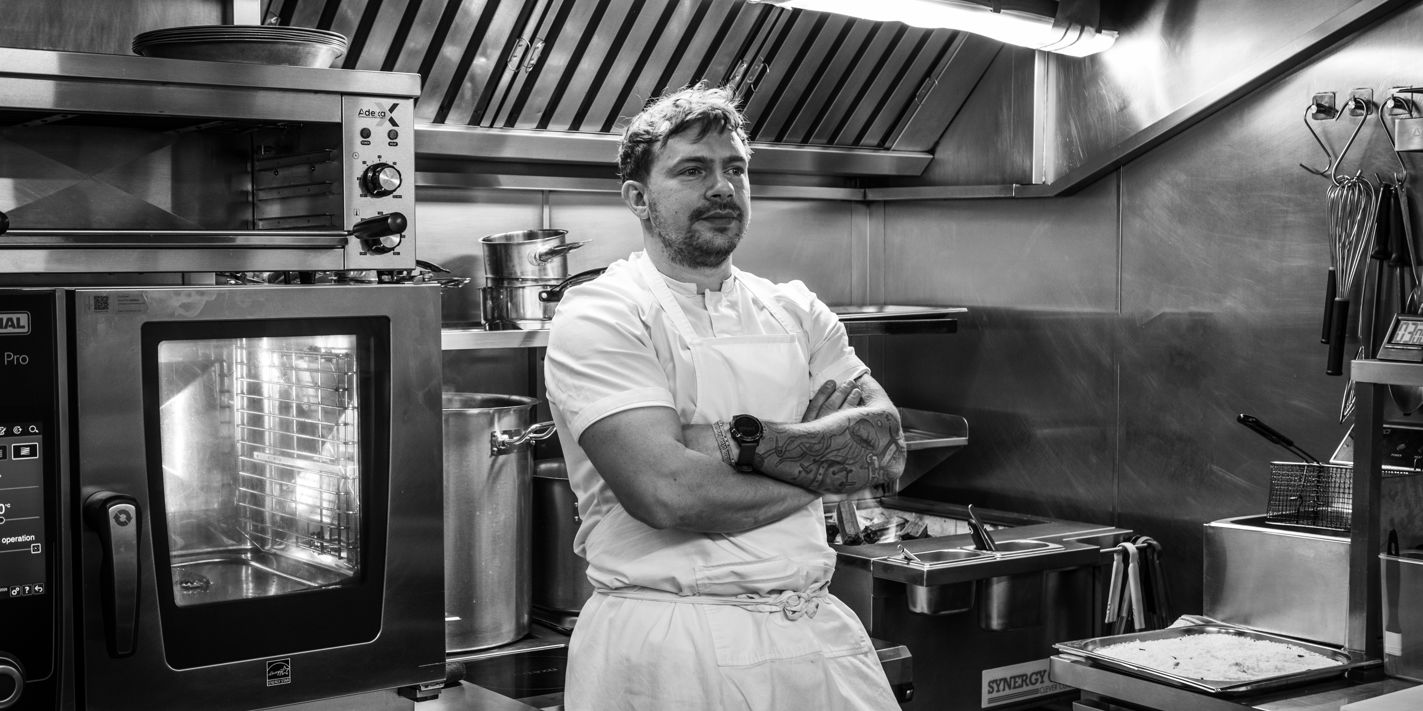
Eugene Korolev
No one ever said being a chef was easy. Long hours, high pressure, hot kitchens; those who don’t have an almost obsessive passion for the craft generally don’t last long. That’s magnified tenfold when you start looking at the upper end of fine dining and Michelin-starred kitchens. It’s something chef Eugene Korolev knows all too well –although his time fighting Russia in the Ukrainian army certainly puts things into perspective.
Eugene grew up in Dnipro, eastern Ukraine, without any real interest in food. Instead, he was – like many of his friends – obsessed with football. He even played it professionally in his teens. A combination of injuries and his family wanting him to go to university meant his sporting career never really took off, but football’s loss was the kitchen’s win.
‘I needed to make money while I was at university, so my friend and I started going into random restaurants and asking for whatever jobs they might have going,’ says Eugene. ‘Eventually a Japanese-Italian fusion restaurant said they needed bartenders and to come back the next day. When we arrived they said they didn’t need bartenders anymore – but they needed chefs. So I thought, ‘cool, I’m a chef now’.’
Eugene had no idea what he was doing during the first few months in the kitchen, but that bewilderment soon turned into a thirst for knowledge. After five years, he wanted to see what else was out there. Over the next decade, he worked his way through five-star hotels, Michelin-starred kitchens and relaxed bistros. Each one taught him something new. A place in Warsaw, focused on molecular cuisine, taught him the value of creativity. His time in Paris allowed him to get to grips with the complexity of classical cookery. A spell in Germany cemented the importance of consistency. By the end of it, Eugene was a seriously accomplished chef.
After returning home to Dnipro, Eugene opened his first restaurant in December 2021. ‘There was no more time to learn,’ he says. ‘I had to set out on my own and see if it would work. I wanted to celebrate Ukrainian cuisine but in an elevated and modern way, taking the lessons I’d learned from all the kitchens I’d worked in.’
The restaurant opened to rave reviews and Eugene had an incredible team around him. But just three months later, war with Russia was on the horizon. ‘I knew I would join the army and defend Ukraine if Russia invaded,’ he says. ‘It wasn’t even a question. You feel the need to protect everyone you care about. No one at the restaurant wanted to flee west, so some of us joined the army, while the rest kept the business running.’
The restaurant quickly pivoted from serving paying guests to cooking for the national guard and local hospitals. When it became clear the war wasn’t going away, it opened to the public again, as locals wanted some sense of normality.
‘The first year was really tough – there were a lot of blackouts and a focus on just surviving more than anything else,’ he says. ‘But after 12 months we started to think differently. We started to believe in ourselves more and it felt like we could breathe a little easier. I think a lot of us finally accepted that the army was our new life and not a temporary thing.’
While fully focused on the war, Eugene kept in constant touch with his team back at the restaurant. He would talk about food all the time with the other members of his unit, and even cook what he found in abandoned houses where possible. He’d accepted this was his future, until he was contacted by Polina Sychova, a restaurateur and interior designer who was planning to open a Ukrainian restaurant in London. After a two-hour phone call, it was clear they shared the same vision.
‘I’d been writing down recipes and new ideas for a restaurant while I was with my unit, but didn’t think I’d get the chance to actually use them,’ he says. ‘When the other soldiers heard I had this opportunity they all convinced me to go for it. They knew I was strong in the kitchen and a chance to shine a spotlight on Ukrainian cuisine and culture was really important. So I talked to my commander, who agreed, and he and an army lawyer helped me get everything together to leave the army and get a visa for the UK.’
In September 2023, after 18 months fighting for his country, Eugene headed to western Ukraine to cook for Polina. ‘I had just eight hours to create a 24-course tasting menu that showcased the sort of Ukrainian cuisine I wanted to cook in London,’ he explains. ‘A month later I was living in the UK with my partner.’
Eugene says it took him about three months for this new reality to sink in. After fighting on the front lines, living in London was like a dream come true – but it wasn’t without its challenges. ‘It took me some time to recover and get used to life without war, and I hadn’t seen my partner for so long,’ he says. ‘London is very busy and very fast-paced, and the responsibility of making the restaurant a success was huge. But many of the issues we have in Ukraine don’t exist here. You can get any ingredient you want, delivered when you want, at the very best quality. I found it unbelievable. In Ukraine the only way to get fresh fish was if you knew someone who could catch it.’
After months of menu development and tastings, Polina and Eugene’s restaurant Sino (meaning ‘hay’) opened in Notting Hill in May 2025. Eugene was able to bring chefs from his old restaurant in Dnipro over to work in the kitchen, and it instantly became a bastion of Ukrainian culture in the city. ‘Of all those dishes we cooked back in Ukraine, only one remains on the menu – a cherry-glazed catfish,’ he explains. ‘Everything else was adapted or changed to better appeal to local tastes. I didn’t want Sino to feel like a relic or a place where you can only get traditional Ukrainian food; I wanted to make it stand out and show how far you can push and elevate Ukrainian flavours.’
The dishes at Sino are certainly elevated – there are homemade garums, complex ferments, beautiful garnishes and playful takes on classics like chicken Kyiv and borsch. The space itself is beautiful with serious attention to detail; the ceramics the dishes are served on, for example, took months to arrive from Ukraine, as the studio making them could only work a few hours a day due to the war and blackouts.
Eugene sees Sino as more than a restaurant. He sees it as paving the way for other Ukrainian chefs to look inwards at their own heritage, rather than cooking other European cuisines. ‘We have lots to share with the world and I truly believe Ukrainian food has so much undiscovered potential,’ he says. A meal at Sino, prepared by the skilled chefs in the kitchen, certainly confirms that.