
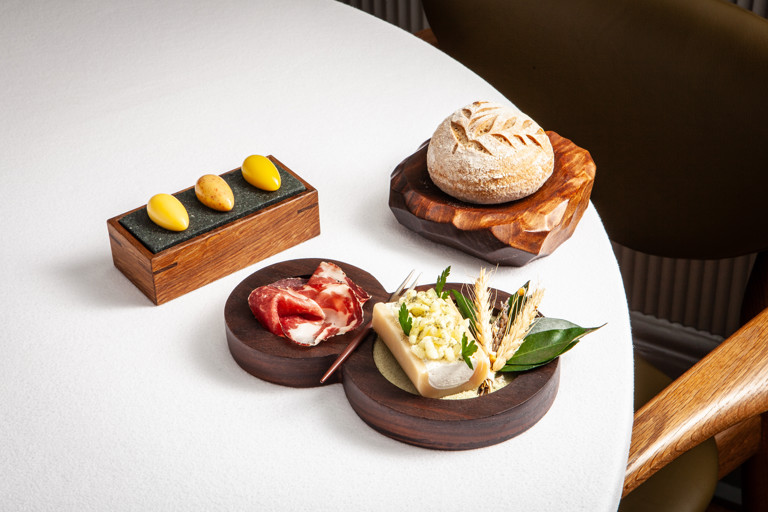
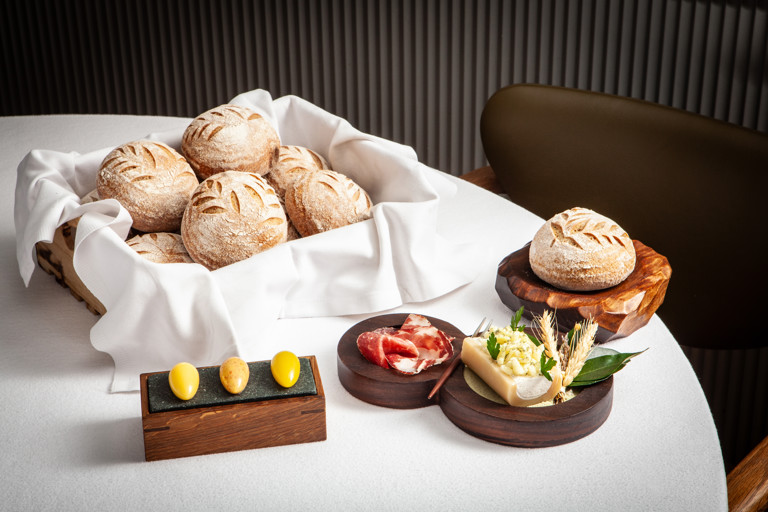
Sourdough with whipped bone marrow, cultured butters and coppa
- medium
- 10
- 2 hours 50 minutes plus 72 hours fermenting, chilling and dehydrating time
Rafael Cagali ferments cream with buttermilk to make a duo of salt and pink peppercorn cultured butters, along with a whipped olive oil and whipped bone marrow. These are served with slow-fermented sourdough rolls and coppa.

Note: Rafael uses his own sourdough starter, which he has fed daily for 10 years with equal parts lukewarm water and Shipton Mill bread flour to equal parts of the starter. He feeds it 12 hours before using it to ensure it is ripe.
Ingredients
Metric
Imperial
CULTURED BUTTERS
- 150g of buttermilk
- 300g of double cream
- pink peppercorns, ground into a powder
SOURDOUGH
- 475g of white bread flour, (Rafael uses Shipton Mill flour), plus extra to dust
- 54g of strong wholemeal flour
- 380g of filtered water, chilled
- 38g of black treacle
- 135g of sourdough starter, ripe (see note)
- 17.5g of fine sea salt
BONE MARROW
- 60g of sage leaves
- 10 centre-cut beef marrow bones, washed thoroughly then soaked in water overnight to get rid of blood
- 6 tsp dehydrated potato shreds
- parsley leaves, to garnish
- vegetable oil, for deep-frying
WHIPPED OLIVE OIL
- 10g of Glice Emul emulsifier
- 100g of olive oil, (Rafael uses Gonnelli olive oil)
TO SERVE
- coppa, (Rafael cures his own at De Terra)
Equipment
- Round mini bannetons
- Dehydrator
- 600mm x 400mm silicone quenelle mould
- Deep fat fryer
- Temperature probe
Method
For the cultured butters, first make a fermented cream. Mix the buttermilk and cream together, pour into a container and cover loosely with a clean cloth so the air can get to it. Leave in a cool, dark place at room temperature for at least 48 hours, whisking every 12 hours and tasting to check the flavour – it’s ready when you have a sufficiently sour flavour
- 150g of buttermilk
- 300g of double cream
Once the fermented cream is sour enough, place it in the fridge for 24 hours
For the wholemeal sourdough loaves, place the flours, water and treacle in a stand mixer fitted with a dough hook and mix for 5 minutes on a low (but not the lowest) speed
- 475g of white bread flour, (Rafael uses Shipton Mill flour)
- 54g of strong wholemeal flour
- 380g of filtered water, chilled
- 38g of black treacle
Add the starter and mix for a further 5 minutes until fully incorporated
- 135g of sourdough starter, ripe (see note)
Add the salt, turn down to the lowest speed and mix for a further 5 minutes
- 17.5g of fine sea salt
Roll the dough out onto a floured work surface in a warm part of the kitchen. Fold it every 10-20 minutes to help create tension and structure in the dough, until it feels tough – the length of time depends on the warmth of your kitchen – typically this will take 3-5 hours (cover with a cloth in between folds)
- white bread flour, (Rafael uses Shipton Mill flour), extra to dust
Divide the dough into 110g portions, being mindful not to degas the dough. Once portioned, shape the dough into balls, transfer to round mini bannetons, cover and place in the fridge to prove overnight
Chill the bowl of a stand mixer in the fridge or freezer ahead of making the butter
To make a sage powder to garnish the bone marrow, dehydrate the sage leaves in a dehydrator at 38°C for 2½ hours, until crisp and crumbly. Blitz into a powder in a spice grinder and set aside
- 60g of sage leaves
After 24 hours in the fridge, place the fermented cream in a stand mixer fitted with a whisk attachment and whisk until the mixture splits into butter and buttermilk – make sure the mixture stays cold as you whisk
Strain the butter and buttermilk through a colander set over a bowl then lightly squeeze the butter in a clean cloth to remove excess buttermilk
Weigh the butter to calculate 1.5% of its weight in salt then beat that in using a spatula or electric whisk
Split the butter in half and set half aside. Weigh the remainder to calculate 3% of its weight in ground pink peppercorns, then beat that in using a spatula or electric whisk. Set the 2 flavoured butters in a 600mm x 400mm silicone quenelle mould in the fridge
- pink peppercorns, ground into a powder
For the whipped olive oil, use a handheld blender and a tall narrow jug to emulsify the Glice Emul and olive oil together to a butter consistency. Set in a 600mm x 400mm silicone quenelle mould in the fridge for a minimum of 4 hours (this will make double what you need)
- 10g of Glice Emul emulsifier
- 100g of olive oil, (Rafael uses Gonnelli olive oil)
To bake the sourdough, preheat the oven and a baking tray or pizza stone to 250°C
Invert the loaves onto the hot tray, score with a razor blade to a depth of 2mm and bake for 14 minutes (you may have to work in batches). Transfer to a wire rack to cool and reduce the temperature to 180°C
For the bone marrow, roast the bones for 1 hour to melt the marrow. Once melted, scoop out the marrow and put in a container to cool to room temperature. Clean the bones and reserve
- 10 centre-cut beef marrow bones, washed thoroughly then soaked in water overnight to get rid of blood
Once the marrow is cool, use a balloon whisk to whip it until it reaches the consistency of butter. Store in the fridge in an airtight container if not serving right away
Ahead of serving, bring the whipped marrow up to room temperature if needed, then transfer to the cleaned bones. Remove the butter from the moulds and leave to come up to room temperature
For the potato topping, heat the vegetable oil in a deep pan over a medium-high heat, or preheat a deep-fat fryer to 180°C. Deep-fry the dehydrated potatoes shreds until puffed for a few seconds, then drain on kitchen paper
- vegetable oil, for deep-frying
- 6 tsp dehydrated potato shreds
To serve, garnish the bone marrow with the sage powder, the puffed potatoes and parsley leaves. Serve with 1 sourdough roll, 1 quenelle of each of the cultured butters and olive oil per person and some coppa
- parsley leaves, to garnish
- coppa, (Rafael cures his own at De Terra)
Get in touch
Please sign in or register to send a comment to Great British Chefs.