
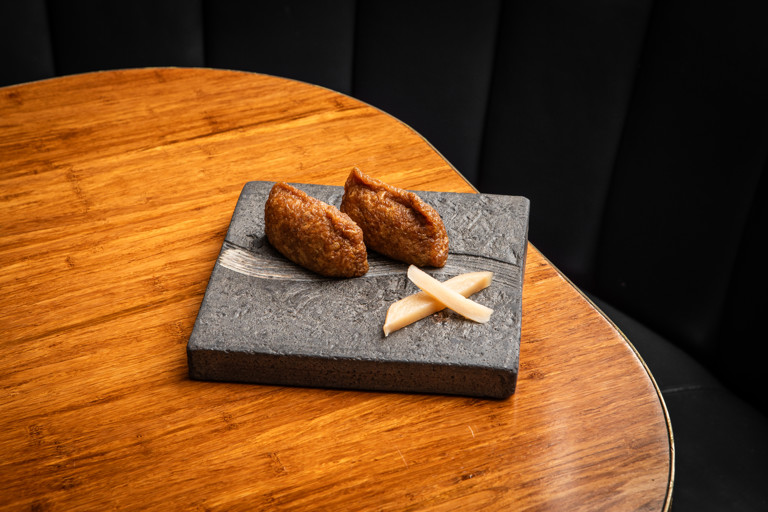
Inari sushi with British smoked eel
- medium
- 12
- 2 hours plus overnight infusing
Inari sushi is one of the more popular types of sushi, which sees rice stuffed inside a ‘pouch’ of braised, sweet fried tofu called abura-age. Chef Masaki puts his own twist on the dish by using ingredients such as date molasses, palm sugar and white balsamic vinegar in his sushi vinegar and for braising the abura-age, before combining the rice with little nuggets of smoked eel.
Don’t be put off by the number of steps – many of them go into detail about how to wash, cook and season the rice to really bring out its texture and flavour.

Ingredients
Metric
Imperial
- 250g of Japanese short grain rice, Masaki uses Nanatsuboshi variety
- 240g of filtered water, or soft mineral water
- 30g of smoked eel fillet
- 10g of toasted sesame seeds
- 5 shiso leaves, or 2 larger leaves, finely julienned
Sushi vinegar
- 250g of rice vinegar
- 8g of dried kombu
- 100g of palm sugar
- 40g of caster sugar
- 30g of sea salt
- 40g of mirin
- 20g of date molasses
Abura-age
- 300g of filtered water, or soft mineral water
- 12g of dried kombu
- 6 pieces abura-age
- 50g of Japanese soy sauce (shoyu)
- 20g of palm sugar
- 15g of caster sugar
- 15g of white balsamic vinegar
Method
The day before you plan to serve, prepare the dashi for the abura-age. Combine the water and kombu in a non-reactive container, then cover and refrigerate overnight. Don’t cut the kombu as it can create a slimy texture
- 300g of filtered water, or soft mineral water
- 12g of dried kombu
You can make the sushi vinegar the day before as well. Put the vinegar and kombu in a saucepan and set aside to infuse for 30 minutes at room temperature
- 250g of rice vinegar
- 8g of dried kombu
Gently heat the vinegar until it reaches 65°C. Remove from the heat and allow to cool to room temperature
Remove the kombu and set aside. Reheat the vinegar to 65°C, then remove from the heat once again. Add the palm sugar, sugar and salt, stir until dissolved, then add the mirin and date molasses, stirring to combine. Return the kombu to the vinegar and store in a sterilised, airtight container in the fridge until ready to use
- 100g of palm sugar
- 40g of caster sugar
- 30g of sea salt
- 40g of mirin
- 20g of date molasses
The next day, cut each piece of abura-age in half. Insert your thumb into the cut side of each piece and gently tease open the pouch towards, taking care not to tear the tofu
- 6 pieces abura-age
Bring a pan of water to the boil. Add the abura-age and boil for 2-3 minutes to remove excess oil. Drain and transfer to cold water to halt the cooking process
Gently spread 2-3 pieces of abura-age across your palm and press down firmly to squeeze out excess moisture. Arrange the abura-age in a large, wide pan, in a single layer so they sit at a uniform height (use more than 1 pan if you need to)
In a separate small saucepan, add the soy, both sugars and 250g of the infused dashi. Bring to the boil, stirring to dissolve the sugars, then pour the mixture over the abura-age
- 50g of Japanese soy sauce (shoyu)
- 20g of palm sugar
- 15g of caster sugar
Place the pan of abura-age over a high heat. When the liquid comes to the boil, cover with a cartouche, reduce the heat to medium-low, then leave to simmer until the liquid has reduced by half
Remove from the heat, add the white balsamic vinegar, then leave the abura-age to cool in the pan while you prepare the rice
- 15g of white balsamic vinegar
Put the rice in a bowl then add water directly from the tap and immediately start mixing the rice vigorously with your hand in a circular motion
- 250g of Japanese short grain rice, Masaki uses Nanatsuboshi variety
As soon as the water covers the rice, place your hand at the bottom of the bowl and gently wave to loosen the grains. Quickly pour off the cloudy water
Repeat this process 2-3 more times, until the water becomes noticeably lighter. Drain off as much water as possible, then level the surface of the rice
Put your right hand into the rice at 12 o’clock and move toward 10 o’clock, gathering the grains. At the 10 o’clock position, turn your hand over and use your palm to push the rice diagonally back towards 12 o’clock, lightly rubbing the grains together
Rotate the bowl slightly clockwise with your left hand to bring some unwashed rice into position. Repeat the 12 o’clock to 10 o’clock and back to 12 o’clock process again, then turn the bowl slightly and repeat. Continue to do this until you have completed a full circle
Cup your hand and gently mix the entire batch of rice to ensure even washing. Add fresh water and rinse away the rice bran. Repeat this until the water is no longer yellowish
Transfer the rice to a colander, slightly angled to allow for more efficient drainage, then leave to drain for 10-15 minutes
Combine the drained rice and filtered water in your cooking vessel – ideally a donabe pot, but a thick, heavy saucepan or cast-iron casserole will work too. You do not need to soak rice if it’s being made into sushi rice
- 240g of filtered water, or soft mineral water
Cover the pot with a lid and gently cook over a medium-low heat for 10 minutes
Increase the heat to high and cook until the water boils and steam begins to escape. Reduce the heat to low and simmer for 10 minutes
Increase the heat to high for 10-15 seconds, then turn off the heat and leave the rice to steam, covered, for 10 minutes
Remove the lid and gently transfer the rice to a hangiri wooden tub, or a wide, non-reactive container. If you’re using a hangiri, make sure you’ve wiped the surface with a damp cloth at least 10 minutes before adding the rice to condition the surface
Weigh out 115g of the sushi vinegar (excluding the kombu), then evenly drizzle it over the rice, ensuring all the grains are lightly coated
Use a rice paddle to gently break up large clumps of the rice, starting from the edges. Once the clumps are separated, scoop and turn the rice to distribute the vinegar evenly and use the rice paddle in a sideways cutting motion to separate any remaining unseasoned grains without crushing them
Use a fan to cool the rice until it’s just warm – around body temperature – then turn the rice once more to cool the bottom layer evenly, maintaining a light and glossy texture
You are now ready to assemble the inari sushi. Lightly grill the smoked eel over charcoal until just warmed and aromatic (or warm it through in a pan). Cut into 5mm cubes
- 30g of smoked eel fillet
In a bowl, weigh out 420g of the sushi rice, then gently combine with the smoked eel, sesame seeds and shiso, taking care not to crush the rice
- 10g of toasted sesame seeds
- 5 shiso leaves, or 2 larger leaves, finely julienned
Gently squeeze the excess liquid from the braised and cooled tofu skins without tearing them
Divide the rice mixture into 12 equal 40g portions and lightly shape so they fit snugly into each inari skin. Tuck the opening over itself to seal the inari, then serve
Get in touch
Please sign in or register to send a comment to Great British Chefs.