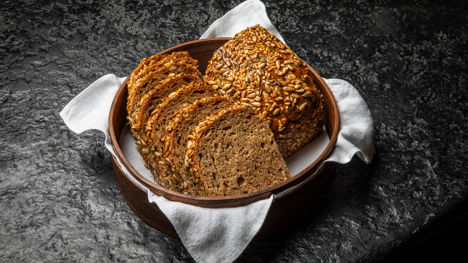
Einkorn, honey and lemon thyme bread
- medium
- 12
- 60 minutes plus 7 days fermenting time, at least 2 hours resting and proving time and 33 minutes baking time
Adam demonstrates classic sourdough bread-making techniques with a nod to heritage rich and chewy einkorn wheat in his method for these flavoursome loaves. Adam reheats the bread brushed in honey made from bees kept in Coworth Park near Ascot in Berkshire, serving the bread as part of his tasting menu. Adam has provided the recipes for his sourdough starters too, using both einkorn flour and regular wheat bread flour.

Note: For easy planning, the next time you make a sourdough loaf, keep back 120g of the dough so you can bake this bread the next day. If you don't have fermented dough, simply add an extra 70g einkorn flour and 50g water at step 6.
Ingredients
Metric
Imperial
WHITE STARTER
- 350g of white bread flour, or more as needed
- 350g of tepid water, or more as needed
- 25g of honey
EINKORN STARTER
- 350g of einkorn flour, or more as needed
- 350g of tepid water, or more as needed
- 25g of honey
BREAD DOUGH
- 210g of water
- 120g of fermented bread dough, (see note)
- 300g of einkorn flour
- 1g of fast-action dried yeast
- 12g of fine sea salt
- 10g of lemon thyme, leaves picked
- 20g of pumpkin seeds, plus extra for the top
- 20g of sunflower seeds, plus extra for the top
- 20g of linseeds, plus extra for the top
TO FINISH
- honey, for brushing
- 5g of lemon thyme, leaves picked
Equipment
- 600g loaf tin
Method
Make the sourdough starters at least 7 days before you want to bake the bread. You can make each starter with the same instructions, but the einkorn starter will behave differently (see step 4). In 2 separate bowls, mix the honey into the water, combine with the flours and transfer to 2 separate clean containers (jars work well). Cover loosely and leave at room temperature (around 20-25°C) for 24 hours
The next day, you may or may not see bubbles – this is normal. Discard about half of each mixture then mix in 50g flour and 50g water into each one. Stir well, cover and leave for another 24 hours
For the next 5 days, repeat the process as above, discarding half of each mixture and feeding with 50g flour and 50g water
After a few days, the starters should become bubbly, develop a pleasant tangy smell, and bubble and rise after feeding. The einkorn starter has a weaker gluten structure, making it stickier than the white starter – almost paste-like in texture. It will also rise but because of the lower glutinous structure it will quickly collapse back down again
The starters are ready to use when they double in size within 4-8 hours after feeding, have lots of bubbles throughout, smell pleasantly sour (like yoghurt or fruit) rather than unpleasant or rotten. If you plan to bake often, feed them daily and keep at room temperature. If baking occasionally, store in the fridge and feed once a week and feed once or twice the day before you plan on baking
For the bread dough, put all of the ingredients in the bowl of a stand mixer with 60g white starter and 60g einkorn starter, starting with the water, and making sure the salt and yeast, white and einkorn starters are not in contact. Mix everything for 5 minutes on the lowest speed, then increase the speed a little and mix for another 5 minutes. Transfer to a plastic container, cover and set aside for 30 minutes
- 210g of water
- 120g of fermented bread dough, (see note)
- 300g of einkorn flour
- 1g of fast-action dried yeast
- 12g of fine sea salt
- 10g of lemon thyme, leaves picked
- 20g of pumpkin seeds, plus extra for the top
- 20g of sunflower seeds, plus extra for the top
- 20g of linseeds, plus extra for the top
Wet your hands to prevent the dough sticking, then fold the dough in on itself 4 times, by stretching it upwards and folding it over the centre. Rotate the bowl 90 degrees and repeat this process on all 4 sides. Cover and leave at room temperature for another 30 minutes
Remove the dough onto a clean surface, shape it into a log around the width and length of a 600g bread tin then transfer to the tin
Mix some extra seeds together and sprinkle over the top. Leave to prove until the bread comes three-quarters of the way up the sides of the tin and leaves a small indent and doesn’t spring all the way back when lightly pressed
- pumpkin seeds, extra for the top
- sunflower seeds, extra for the top
- linseeds, extra for the top
Preheat the oven to 250°C (or as high as your oven will go) and place a large lidded casserole (dutch oven) large enough to fit the loaf tin into the oven to heat up (Adam has professional deck ovens at Woven). Alternatively, if you don’t have a dutch oven you can preheat a pizza stone with a tray on the bottom of the oven to create steam (simply add some water to the tray when the bread goes in)
Place the bread in the dutch oven (or on the pizza stone, if using) and bake for 20-25 minutes, turning it after 20 minutes and baking for a further 5-10 minutes depending on how dark it is
Carefully remove the bread from the dutch oven and its tin, then return to the oven (directly on the oven shelf or on a baking sheet) for 5 minutes, to brown the sides. Cool on a wire rack
Before serving, preheat the oven to 185°C. Brush the loaf with honey (loosen with a little water over a low heat, if needed) and sprinkle over the lemon thyme leaves. Warm in the oven for 8 minutes, then slice and serve. The bread can be well-wrapped and frozen or kept for up to 3 days in a cool, dark place
- honey, for brushing
- 5g of lemon thyme, leaves picked
During his time working under John Williams at The Ritz for almost ten years, Adam Smith fell in love with the complexities of classical cookery. Now a Roux Scholar and executive chef at the Michelin-starred Woven by Adam Smith, at stunning hotel Coworth Park, he puts his own spin on classic combinations that showcase the pinnacle of flavour, technique and plating.
Get in touch
Please sign in or register to send a comment to Great British Chefs.