Sea salt: more than a seasoning
by Great British Chefs20 February 2026

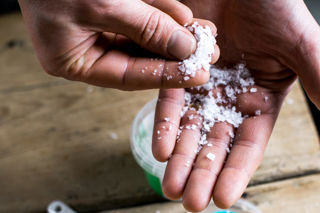
A life without salt would be a very sad life indeed. It wouldn’t even be a life – we need the stuff to stay alive. But for many of us, it’s seen as something we sprinkle over a dish right before eating it, or something we throw into boiling water before we add pasta.
Chefs, however, know that salt has so much more to offer. It can alter texture as much as it can taste; it can completely transform ingredients or massively extend their shelf life. When, where and how you use salt can lead to wildly different results in your cooking.
The type of salt you use is important too. ‘Processed salts – often called table salt – are normally made up of sodium and chloride ions, plus some bleaching and anti-caking agents,’ says Philip Tanswell, managing director of Cornish Sea Salt. ‘But natural sea salt contains potassium and sodium, which balances blood pressure, along with all the other minerals and electrolytes we need in our bodies to be healthy.’
It’s generally agreed that sea salt is the best salt to use in your cooking from both a taste and a health perspective, but the form that sea salt takes can change how it reacts with your cooking too. Cornish Sea Salt produces crunchy crystals, delicate flakes that you can crush between your fingers and flavoured salts (including smoked sea salt flakes) to offer even more versatility.
‘I’d use a crystal salt wherever the salt is going to dissolve – so in a brine or in baking,’ says Chantelle Nicholson, chef-owner of Apricity in Mayfair, London. ‘Flaked sea salt is for finishing, putting in salads or any use where the food is going to be eaten pretty swiftly. Smoked salt gives you an extra layer of flavour, as it both seasons and adds that little extra richness.’
We all know a dish that hasn’t been seasoned with salt can taste a little flat and dull – but how you get that seasoning into the dish can take many forms. ‘Cornish Sea Salt is obviously harvested right by the sea in the UK in a beautiful spot,’ says Chantelle, ‘and in terms of the kind of circularity of how they produce the salt, it aligns with my ethos. The versatility of sea salt, however, is something chefs probably take for granted more than home cooks. We use salt at the beginning of cooking, during it and then at the end, as well as utilising it to create brines, alter the texture of other ingredients, firm up fish or tenderise meat… it’s got so many different applications beyond seasoning.’
‘Since I did a taste test with Cornish Sea Salt, I haven’t used any other salt,’ adds Jude Kereama of Kota and Kota Kai in Porthleven, Cornwall. ‘It helps that I can see the source of the salt from my house! But you wouldn’t believe how much it enhances simple ingredients. I use it in all my cooking, be it curing fish, making salt-crust pastries to bake vegetables or chicken in, or even in my desserts, where it adds balance to chocolate, caramel and fruit.’
A brine is, essentially, cool salted water (sometimes with other flavourings added), which you can then add your ingredients to before you cook them. This does several things; through the magic of osmosis it draws out moisture from within the food and replaces it with the brine, ensuring it is seasoned throughout instead of just on the surface. It can also change the texture of an ingredient, tenderising tough cuts of meat or breaking down vegetables. Leave it long enough and it’s the basis for fermentation too – many of our favourite ferments such as sauerkraut, kimchi and dill pickles are essentially preserved in a light brine, which completely changes the ingredients’ tastes and textures.
While a brine sees salt dissolved into water, a cure sees the salt added directly to an ingredient. The process works in a similar way; the salt draws out moisture from whatever’s being cured, which – if left long enough – then mixes with the salt to create a very intense brine. This of course seasons the ingredient, but the real aim of curing is to preserve. As more moisture is drawn out of the ingredient (usually fish or meat), it firms up and becomes drier, increasing its shelf life. This is the technique that’s responsible for many of our favourite foods (charcuterie, gravadlax, bacon) and is often paired with smoking, as the dry, ‘tacky’ texture of a cured ingredient gives the smoke something to stick to. It also doesn’t have to be a long process at all – sprinkling some sea salt over a fillet of fish and leaving it for just 15 minutes will firm it up and give it a stronger texture – a little trick many chefs use in professional kitchens.
Sticking with preservation, pickling usually involves a combination of sea salt, vinegar, water and sugar, which is then heated until the salt and sugar dissolve. Ingredients are then submerged in this liquor to pickle. This can be a quick pickle, in which case the liquor is usually introduced to the ingredients while still hot and takes around an hour or so, or a longer, more traditional pickle, which sees the cool liquor and ingredients sealed in a jar or container and left for days, weeks or months. Salt, vinegar and sugar are all natural preservatives, and when they’re used in unison they can technically keep ingredients safe to eat indefinitely.
Salt can be a key component in traditional cooking, too. Salt-baking is a nifty method which sees a very salty dough – generally made with flour and water or whipped egg whites – completely covering an ingredient before it goes into the oven. As the dough bakes and firms up, it creates a tight, salty seal around the food, seasoning it thoroughly and protecting it from the harsh heat of the oven. It works in a similar way to when you wrap fish in baking paper and cook it en papillote – the food steams inside the paper or salt dough, resulting in a very different texture to if it had gone into the oven unprotected.
All these techniques are important skills to have in your culinary arsenal, but arguably most important is knowing how to season your food properly. A little sprinkle of good quality sea salt just before serving a dish is generally a good idea, but most chefs will add salt at the beginning of cooking a dish, as well as throughout. If you wait until the very end to season, the salt won’t have had time to truly combine with all the ingredients. Adding the same amount of salt in three stages versus one stage at the end will result in a much tastier plate of food that is evenly seasoned throughout. The main thing to keep in mind, however, is to taste as you cook – a simple task which so many of us fail to do until the very end.
It’s clear that sea salt should be a cornerstone of any kitchen, professional or otherwise. But knowing its true potential, whether to use crystals or flakes and how best to incorporate it into your food makes all the difference.
Please sign in or register to send a comment to Great British Chefs.