Plenty of fisheries: Greenland's very special cod
by Esme Curtis28 January 2026

One of the first things Harriet Mansell (chef-owner of the recently closed Robin Wylde in Dorset) did when we arrived at Royal Greenland’s headquarters was ask if we could look at a map. Lili, a member of Royal Greenland’s marketing team, patiently waited as we all looked in amazement at the seemingly endless stretch of white.
Greenland is big. It’s not nearly as big as it appears on the Mercator projection, where it’s distorted into something almost the size of Canada, but it is big. To use a traditional British form of measurement, it’s over 100 times the size of Wales – or 2.1 million square kilometres. And the vast majority of that expanse is an ice sheet which stretches across the island like a frosty blanket, not quite reaching to the edge. It’s that border around the edge of the ice sheet which Greenlandic people have made their home. It’s rocky, mountainous and breathtakingly beautiful.
The vast majority – around 90% – of people in Greenland are Greenlandic Inuit. Although those in the capital city of Nuuk can, of course, go to the supermarket and buy fish and meat, traditional ways of hunting and fishing are still extremely popular and widely practiced. This is a nation where boats vastly outnumber cars, and everywhere we went people regaled us with stories of their favourite adventures. Up in Ilulissat, our young boat captain told us his grandma has a freezer where she stores the meat, and when she runs low she sends him off to hunt for more. When we arrived in Greenland, it was towards the end of reindeer hunting season. Myself, Harriet and Jude Kereama – executive chef and owner of Cornwall’s Kota and Kota Kai – and Arne, who works in sales, were shown photos of the marketing team’s latest exploits battling mosquitoes and eating dried fish while they hunted reindeer. Arne told us that his son had shot his first reindeer at 12 years old. They froze the meat and then ate it at his confirmation later that year.
Wild food is always seasonal, but in Greenland ‘seasonality’ takes on a whole new meaning. In the depths of winter in Nuuk, there are just four hours of daylight. For Greenland, that’s quite a lot. In Qaanaaq, one of the country’s northernmost towns, the polar night lasts for around four months. All of this means that when the sun is up and the weather is fair, Greenlanders don’t mess around.
While for many in Greenland fishing is a hobby – albeit a very sacred one – Royal Greenland plays a key role in protecting fishing as a livelihood. The company’s 37 factories are spread mainly in the western part of the country, and 52 per cent of the catch comes from independent fishers. It is the largest employer in the country, and fully owned by the people of Greenland. ‘Everyone in the community in Greenland has a say in it,’ Dan, Royal Greenland’s Sales Manager explained to us. ‘They feel like since they own the company they should have a say in what it does.’
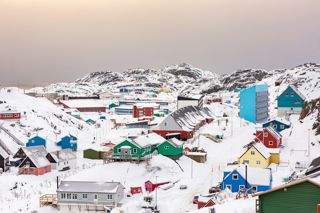
After arriving in Nuuk, we travelled up to the town of Maniitsoq. The fishing town hovers over the Greenland Sea, with houses haphazardly perched along the coastline. After arriving, we had a tour of a Royal Greenland cod factory which produces one of the company’s most prized goods – Nutaaq cod. The cold, pristine waters around Greenland mean that Nutaaq cod grow slowly. Susanne, the factory manager, explained to Harriet and Jude how, unlike with most factories, Nutaaq cod is entirely caught by local fishermen in nets. The expertise developed at Royal Greenland over decades ensures that after freezing the freshness, texture and taste of the cod are preserved, and Nutaaq cod is prized around the world, from the USA to Sweden. All parts of the cod are processed at the factory, from the head to the skin and the cod is, remarkably, processed and frozen within two hours of the fish being stunned and gutted, which gives the fish its firm, dense texture.
Before we arrived, Jude and Harriet wondered what Greenland’s weather would have in store for us. Snowstorms? Ice as far as the eye could see? Unrelenting hail? However, upon arrival the weather turned out to be very mild – for Greenland, anyway. It was a balmy 6°C in Nuuk, and even in the more northern Ilulissat it never dipped below freezing. But this wasn’t always the case.
We visited in September, when Nuuk hadn’t yet had its first snow. In decades past that would have been unthinkable. The ice sheet around Maniitsoq no longer freezes in the winter, and the weather is increasingly unstable. As a nation which is mostly ice, and shaped by fishing and hunting practices, the shadow of climate change looms large. Royal Greenland is doing what it can to keep fishing sustainable; the prawn factory in Ilulissat is powered entirely by hydroelectric power, and the company has strict fishing quotas to prevent overfishing. However, as a nation with a population of just 57,000 people, there is only so much it can do to combat the warming oceans which threaten the fish stocks it relies on.
When I asked if they were enjoying a slightly extended summer, several Greenlanders I spoke with said no: despite the cold and dark, winter was their favourite season. Milu, the head chef at Hotel Icefiord in Ilulissat, explained that when winter sets in you actually have more freedom. It’s easier to get out of Ilulissat in snowmobiles than a car, and the lower numbers of tourists give him time to develop recipes which he can use in the busy season. Similarly, Lili at Royal Greenland told us winter was her favourite season. She loves walking around Nuuk, seeing the winter light displays, and the calmness of the quieter months. ‘People become more gentle with each other in town,’ she noted. While Greenlanders may take full advantage of the light of summer, many also embrace winter as a time to rest.
Back in the UK, when most of us eat frozen fish, it feels very disconnected from its origins. We don’t think about the cold water that gives Atlantic cod its beautiful texture, or the life of the person on the boat. Seeing the journey of Royal Greenland’s fish, meeting the people involved and understanding its critical role in supporting traditional fishing practices changes that. Freezing fish – when done right – captures the essence of where it was caught and the ocean it lived in. And when that fish has enjoyed Greenland’s chilly, pristine waters, it really shines through when it hits the plate.
Please sign in or register to send a comment to Great British Chefs.