Cooking 2.0: how cutting-edge tech took over the kitchen
by Great British Chefs31 July 2026

Being a good cook requires many things. You need to enjoy it – it’s a cliché, but you can tell when you eat a dish someone has loved preparing. The more you cook, the better you get – so practice is key. You need to taste your food as you cook it to ensure the all-important seasoning is spot on. And of course, you need the right tools for the job.
‘Tools’, more often than not, focus on things like pans and knives. But the appliances you use – the ovens and the hobs you’re actually using daily – can make a real difference. A temperamental oven with uneven heat can cause nightmares for even the most seasoned cook; a sluggish hob which takes ages to heat up can cause headaches with timings.
In recent years, kitchen tech has come on leaps and bounds, with clever innovation and design creating dramatic leaps in what our appliances can do. Whether it’s connectivity, efficiency, functionality or just clever little ideas, all of them make cooking more fun and your food taste better. And what home cook (or chef, for that matter) doesn’t want that? The four areas below are where things are really getting exciting in the kitchen – and AEG’s appliances are often the ones leading the charge.
The most useful kitchen tech is often the tech which gives you more control. There’s always an instinctive element to cooking – seeing how thick a sauce is; hearing the sizzle as a steak hits the pan; smelling when something starts to burn – but having some hard data to back things up always helps.
Top-spec ovens like AEG’s often come with temperature probes built in, so you can insert them into joints of meat directly into the oven and know exactly when they’re nearing readiness. Selected AEG SteamPro ovens even come with sous vide modes, which allow you to dictate the temperature to the degree, and there are other modes ranging from the gentle (proving dough; warming plates) to the fierce (pizza mode; air-frying).
Connectivity is a big thing too. While you might wonder why a kettle or toaster needs to be WiFi-enabled, being able to preheat the oven from your phone whilst hosting in the garden or keep an eye on how that lamb shoulder’s cooking from the living room does feel like living in the future. There are even AI assistants, like AEG’s TasteAssist, which will read any online recipe you give it and set up the oven’s settings to match it perfectly – all from the comfort of your sofa.
Of all the functions, settings and tech now available to home cooks, we reckon steam ovens are the most life-changing. If you’ve never used one before, it’s like unlocking a whole new method of cookery. Traditional over-the-hob steamers are great but they lack control; it’s either full steam or no steam. The surface area you have is also limited to the biggest pan and steamer you own.
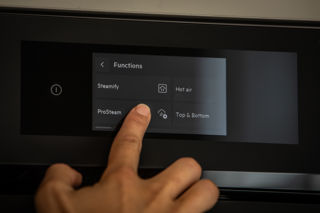
A steam oven takes things to the next level. The space issue is instantly resolved – you have several shelves to put your food on, making steaming a whole fish above a second tray of potatoes easy. But it’s the control over how much steam you use that really makes a difference. AEG’s 8000 ovens use tech called Steamify, which means all you need to do is set the temperature (like a normal oven). It then automatically applies the optimal amount of steam needed to ensure the best texture and flavour. You can use regular full steam for delicate ingredients, or crank up the heat all the way to 230°C and combine lower humidity steam with heat.
This combination of steam and heat – a feature of AEG’s steam ovens – really is a game-changer. You can essentially steam and roast a chicken thigh at the same time, creating a crisp, glassy skin with beautifully tender and juicy meat. You can bake the best bread of your life, incorporating just enough steam to keep the crust light and tender. You can even cook more technical dishes that would require a bain-marie (think custards, crème brûlées and chawanmushi) by keeping the temperature constant and the humidity high.
Induction hobs revolutionised both home and professional kitchens when they hit the market. The tech has been around since the 1970s, but was far too expensive to be viable until improvements started to be made in the early 2000s. Fast-forward to today, and induction is the hob of choice thanks to its efficiency and the fact that it’s almost silent to use.
Modern induction hobs have ‘zones’ rather than ‘rings’, with bridging functions which combine these zones into larger ones for even heating across your largest pans and trays. Changing the temperature on an induction hob will transfer to your pan far more precisely and quickly than traditional gas or regular electric, especially if the hob has a turbo mode, such as AEG’s PowerBoost function. This delivers a short, powerful blast of energy – perfect for bringing water to the boil in seconds or a heavy-bottomed pan to smoking point.
There’s nothing more disappointing than getting a shiny new set of kitchen appliances installed – then noticing little scratches everywhere after the first few uses. With glass and glossy finishes the norm, scuffs and scratches are a bit of inevitability. That’s why new induction hobs such as AEG’s SaphirMatt® are quickly becoming the go-to choice. With a matt black finish and clever innovation, the Saphirmatt® induction hobs are up to ten times more scratch-resistant*.
*Abrasion test conducted externally per IEC 60068-2-70. Scratch visibility assessed internally comparing against our standard ceramic glass hobs without special treatment.
Please sign in or register to send a comment to Great British Chefs.