
Sriram Aylur
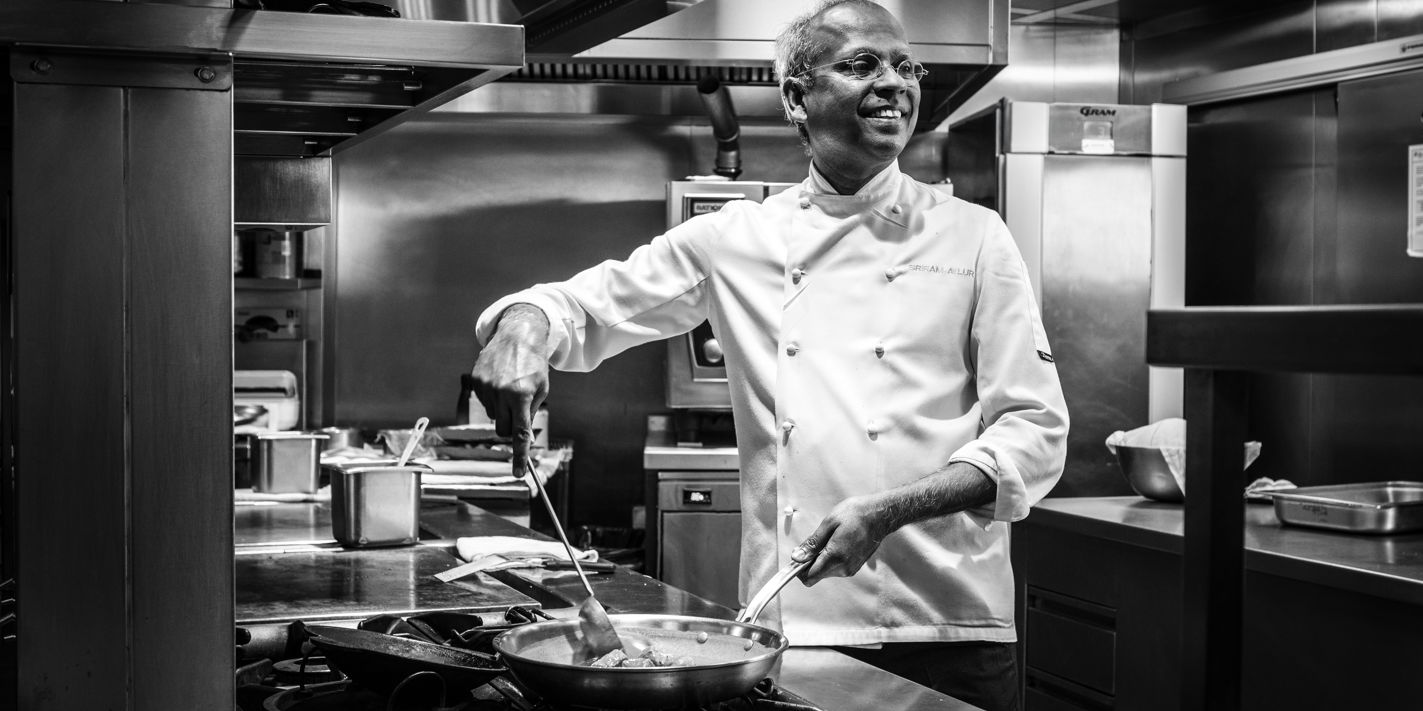
Sriram Aylur
‘Indian’ food is increasingly becoming a bit of an obsolete phrase. It’s a bit like saying ‘European’ food – it gives you a very vague idea of the flavours and ingredients involved but doesn’t touch upon the vast diversity and differences found throughout. More and more restaurants are reacting to this, positioning themselves as not just Indian but focusing on a particular region within the subcontinent. Sriram Aylur, at his trailblazing, Michelin-starred London restaurant Quilon, was one of the first to do this – way back in 1999.
Born in Bombay (now Mumbai), Sriram was all but destined to be a chef. His father ran restaurants and a catering business, and his mother was an incredible cook, particularly when it came to southern Indian dishes. After initially looking to train as a lawyer, the inherent passion he had for all things culinary pulled him back towards the kitchen. ‘During breakfast we'd talk about lunch; during lunch we'd talk about dinner,’ he says. ‘I was always interested in what made dishes succeed or fail, and was blessed with a good palate – I’d analyse the nuances of flavour.’
After helping his father with a new restaurant opening, he knew for sure it was specifically the kitchen he wanted to work in, rather than on the management or business side of things. That meant enrolling in catering college, which then led to joining the famous Taj Group in the 1980s.
The Taj Group run some of the finest hotels in the world, and in India its culinary training programmes are responsible for producing the country’s best chefs. It was on these very programmes that Sriram understood how to run professional kitchens at scale, and with the group’s backing was able to really get to grips with different regional cuisines throughout India. ‘It almost felt like I was working for myself at times, because the Taj Group really backed what I wanted to do,’ he explains. ‘That really came to a head in 1990, when I helped open a restaurant called Karavalli in Bangalore. It focused on the food of southwest India – flavours from Kerala, Karwar, Goa and Mangalore – and was regarded as one of the best restaurants in India within a few years.’
It was opening Karavalli which cemented Sriram’s reputation as not just a great chef, but as a real specialist in southwestern coastal cuisine. The restaurant was so popular that it led to the Taj Group inviting Sriram to move to London and lead the opening of the restaurant next to its Mayfair hotel. ‘There were already plenty of restaurants offering northern Indian food in London, and we wanted to do something regional, so we once again looked to the southwest coast,’ he explains. Quilon, named after a coastal town in Kerala, was born.
When the restaurant opened in 1999, the majority of Londoners had little to no knowledge of how dishes in southwest India might differ from those in the north. ‘I remember one guest in the early days commenting that he’d enjoyed the meal, but was wondering where the naan and chicken tikka masala was,’ laughs Sriram. ‘It took some work and around 18 months of holding strong before we really found our footing. But what started as an uphill struggle soon changed. Anyone who’s lived in London for more than a year or two becomes adventurous. They’re unafraid of spice or unfamiliar ingredients. Generally, people will try things – and if they like it, they’ll come back. That’s what I really love about London.’
People certainly seemed to like what Quilon offered, and they keep coming back – even over 25 years later. The restaurant won a Michelin star in 2008, something it has retained ever since; a testament to Sriram’s ability not just in the kitchen, but knack for keeping things fresh and maintaining incredibly high standards across the board.
It’s important to stress just how pioneering Quilon was when it first opened. Not only did it introduce new flavours and dishes to many diners, it adapted its offering accordingly. Keralan cuisine involves lots of fish and seafood, but the species are different. Rather than shipping over native Indian seafood, Sriram looked to the UK’s own bountiful coast, incorporating the likes of scallops and oysters into traditional dishes. Elsewhere, vegetables you’d never encounter in India such as salsify and purple sprouting broccoli crop up.
To open a restaurant is no mean feat. To win a Michelin star is even harder. But to keep a restaurant going for over 25 years – and maintain its starred status for over 15 of those – is almost unheard of. Sriram credits both the team’s focus on staying true to southwestern Indian cooking and the restaurant’s ability to adapt with the times. ‘Diners are far more health-conscious than they were in 1999, for instance, so we’ve adapted our offering accordingly,’ he says. ‘But the key thing about any art form – music, dance, food – is that it has to remain relevant and representative of its time and place. As long as we can continue to balance that with responding to changes in how people eat out, I believe Quilon will continue to do well.’