Anna Haugh
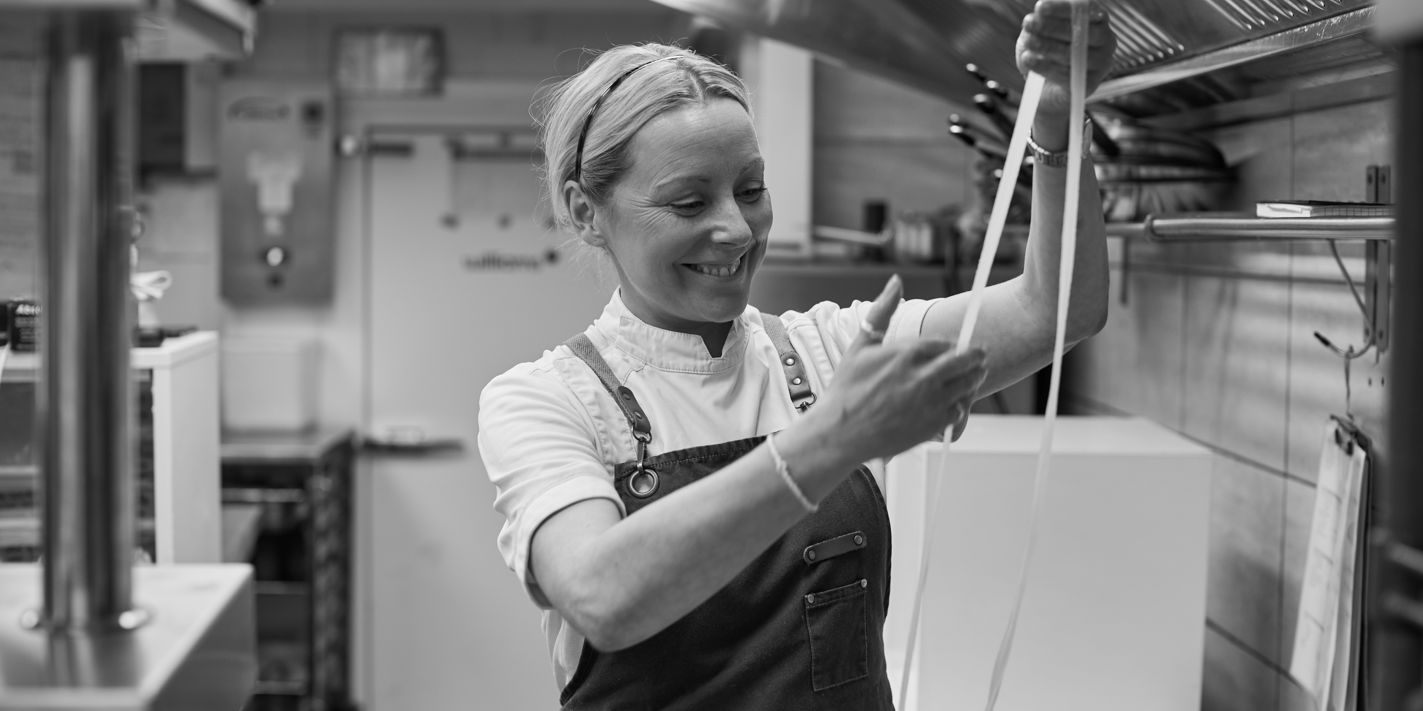
Anna Haugh
Like many chefs, food has been a part of Anna Haugh’s life from a young age: the difference here is just how intrinsic cooking was to her earliest years. Apple and pear trees alongside gooseberry and blackcurrant bushes were plentiful in her home garden growing up, and her mother quickly handed down recipes for tarts, jams, chutneys and the like. ‘She was very strict. To get my pocket money, I had to pick berries and top and tail them to make jam.’
From a very young age, around four or five, Anna’s mother taught her how to tell when fruits were ripe; how to make chicken stock and how to mince meat. It’s little wonder that by the age of 12, she was able to cook for her family of six on her own; as the youngest of four children, this was particularly impressive. It was an expression of a deep-seated desire to feed and nourish those around her, with whatever was available to them at the time. This humble start was a far cry from the glamour of London’s restaurant scene and television shows like MasterChef, Royal Recipes, and Anna Haugh’s Great Irish Food Adventure, which occupy so much of her time today.
In the early days, it was the kind words of a young friend who suggested to Anna that she become a chef. ‘But that just wasn’t a career option back then,’ she says. ‘I knew what restaurants were, but it was as if someone saw me looking at the stars and said ‘you should be an astronaut’ – the jump was too big’.
Anna spent a little time in Jersey, working at a local leisure club with her brother, when suddenly help was needed in the kitchen. ‘For the first time, I had this huge sense of belonging. I didn’t choose the job, the job chose me.’ Returning to Ireland to work her first full-time role at the lauded L'Ecrivain in Dublin, Anna became a part of the team that won the restaurant its first Michelin star, before moving – as many young chefs did – to Paris.
Anna’s desire to learn from the best set her apart: ‘I arrived in Paris with nothing but a knife roll and some chef whites – and my dancing shoes’. That hunger got her a job, working for the pioneering Gualtiero Marchesi at his eponymous Michelin-starred restaurant on Place Vendôme. Marchesi was one of the founders of Italian nouvelle cuisine and at just 21 years old, Anna became the head pastry chef of his lauded Paris restaurant.
But Anna never wanted to be a pastry chef, recalling that back then it was common for women to be cloistered in the pastry section of kitchens while the men handled the meat, fire and savoury menus. Anna would regularly come in on her days off to help in the kitchen, cleaning around the chefs working the sauce and larder sections and watching what it took to cook and serve the food she didn’t yet have access to.
‘It really freaked them out,’ Anna recalls. ‘They told me ‘you are the head pastry chef for Gualtiero Marchesi and a woman will never go higher than that’, so I told them to shove the job up their arse.’
Returning from Paris in the early 2000s and Anna's hunger never diminished. She went on to work at a number of the very best restaurants in London at the time (notably Pied à Terre and Phil Howard’s The Square) before spending nearly three years working for Gordon Ramsay until 2017. It was in the intensity of these male-dominated kitchens that Anna grew into a leader, but she also confesses that her leadership style reflected the culture of the time.
Anna notes that she could be fiery in her younger years, recalling a time when she asked a chef to complete a task, she was met with a cold, uncaring ‘No’. ‘I might have been two feet smaller than this guy,’ Anna remembers, ‘but I’d never heard such disrespect towards a chef. I might have raised my voice more than I should have, but that night I felt such shame. It was then that I knew I had to be a different kind of leader.’ After her role as the group executive chef for Gordon Ramsay, Anna headed up the kitchen at Bob Bob Ricard, however working for other people had run its course. It was time for Anna to forge her own path.

In 2019 when Myrtle opened its doors, Irish hospitality was well known in London, but Irish cuisine was not. Aside from the more established Richard Corrigan and the then on-the-rise Robin Gill, few Irish chefs broke into the mainstream across London and the UK. Outside of the capital, there were very few Irish restaurants in Britain and only a handful of Irish-owned pubs served something recognisable as Irish fare.
And the feeling of Irish cuisine being overlooked wasn’t limited to restaurants; Anna says ‘even six or seven years ago, you couldn’t find a proper recipe for Boxty anywhere online’.
Anna confesses that at the beginning of Myrtle, her dishes might have been a reflection of that wider mood: a consensus that didn't yet fully embrace Irish cookery.
‘In the beginning, I implemented a modern European interpretation of my mother’s recipes, but they weren't always fully Irish’ Anna says. But the evolution of the cookery at Myrtle over the years has seen Anna refocus on her Irish roots and her heritage. Her Michelin-starred training is being skilfully deployed in technique and craft, as opposed to flavour combinations and recipes. Anna's food, like the restaurant itself, has grown, settled, and become more personal.
Now, dishes inspired by Irish stories and folklore with names like ‘Kindred Spirits’, ‘Siobhan’s Quest’ and ‘Salmon of Knowledge’ feature throughout.
It’s a homecoming for Anna, embracing the vastness of her cultural heritage and its capacity for storytelling. This return to Anna’s Irish roots is clearly a deeply personal one. ‘Education was illegal in Ireland at the time when there would have been the biggest abundance of recipes. Talking about this, and encouraging others to talk about this, is crucial. If my mother passed away and I wasn’t doing this, then all of my ancestors' recipes would die with her’.
There is a delicacy to Myrtle that’s rare in London. Anna’s food is delicious, comforting and deeply personal. Leaning into the vast plethora of Irish food traditions, exceptional produce and unapologetic Irish hospitality has paid dividends. Myrtle silently became one of London’s best tasting-menu restaurants, and one that was perfectly placed to ride an explosion of interest in Irish culture.
‘It’s so exciting to be a part of this food and cultural revolution. Irish food was almost forgotten in the UK. Now, Irish food and Irish culture are celebrated: it's everywhere. I’d say in about 5 years' time, you’ll see more Irish food in common conversation, the same way we do with modern European cuisine now.’
Beyond the plate, Anna’s ethos towards kitchen culture has also garnered respect. She tells her teams ‘you don’t work for me, you work for yourself’: an attitude that prioritises wellbeing and hard work as two sides of the same coin. ‘I can tell when a team member of mine needs a hug, or needs a day off. I can also tell when it might be time for them to move on to something new.’ Her staff are encouraged to do the right thing, a reversal of the kitchen behaviour Anna herself came up through, in her own words: ‘Here, we cook with love. Real love.’
For Anna, this is a full-circle philosophy which has its roots in her home cooking, where food is prepared with love and intention. ‘[Your family] will have more romantic food memories if the food is cooked with love,’ she says. ‘My son’s nearly four, and I cook with him all the time.’
The evolution of Myrtle has been largely based around the reworking of the food: refinement and evolution alongside an unapologetic focus on her Irish-ness and that same focus has been applied to the culture of the kitchen. Anna has seemingly rekindled her childhood connection toward food and cooking with heart: on the plate that results in deeply Irish cuisine, and in the kitchen, it results in a team firing on all cylinders. And the story doesn't end there.
For Wee Sister, Anna’s latest venture next door to the main restaurant, a large countertop has become a bistro-style spot for locals: a point that fixes this bar as a hub for those seeking good food and great hospitality locally.
‘As with Myrtle, we’ll take baby steps and keep making solid progress. We have no investors, so we need to take things slowly, but it’s about showcasing more of the very best Irish producers, looking at forming co-operatives to get the best suppliers [into both restaurants] and creating a space where people feel looked after.’
Through her TV appearances, Anna has grown into a nationally loved figure, yet the food at her restaurant feels distinctly personal. Her lauded career and excellent cookery set her apart as one of the UK and Ireland’s best chefs, but her intentional return to the breadth of what Irish food is all about will transcend her restaurants, creating a legacy of Irish excellence that will endure for decades.