Greenland: home of the coldwater prawn
by Great British Chefs28 January 2026

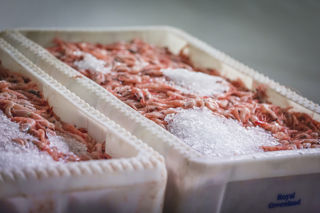
Despite their ubiquity and popularity, coldwater prawns have never been prized in the UK in the same way as France’s langoustines, Southeast Asia’s tiger prawns or Spain’s carabineros. This is perhaps in part because of their size: the same icy, arctic waters which give Greenlandic prawns their sweet flavour and firm texture slow down the shrimps’ metabolism. Even when fully mature the shrimp are just a few centimetres long. In a market where bigger is often presumed to be better, Greenland’s diminutive but tasty shrimp are frequently passed over in favour of their larger cousins.
As a result, Greenland is not always a place chefs associate with quality seafood. Royal Greenland, the government-owned fishing company of Greenland, wants to change that. That’s why they invited top chefs Harriet Mansell (of the recently closed Robin Wylde in Dorset) and Jude Kereama (of Kota and Kota Kai in Cornwall) on a trip around Greenland to learn more about the country’s incredible seafood.
Royal Greenland’s coldwater prawn factory in Ilulissat is one of the largest in the world – a fact that is all the more impressive when you look at where it is on a map.
Ilulissat, whose name means icebergs, is located in the Arctic Circle, about 350 miles from Greenland’s already fairly remote capital of Nuuk. The factory, fully powered by hydroelectricity, overlooks the town’s iceberg-strewn harbour, and is surrounded by picturesque Nordic houses, a steeple-roofed Lutheran church and several boxy hotels for wide-eyed tourists.
Harriet and Jude, two such wide-eyed tourists, had arrived by propeller plane from Nuuk the previous day. Between a breathtaking tour of the town’s nearby icefjord (‘The best day of my life’, according to Harriet), and meeting a local chef, Harriet and Jude were ushered into Royal Greenland’s prawn factory.
The factory can get through around 100 tonnes of MSC-certified prawns per day, and uses state-of-the-art freezing technology to preserve the prawns’ natural sweetness, texture and colour. Just as critically, the factory is a key employer for the local community in Ilulissat, providing year-round jobs.
Tours of the factory are not something Royal Greenland typically permits. Hygiene is absolutely paramount in the factory, and even in low-risk areas there are stringent regulations about hair coverings and hand washing. In high-risk areas, access is generally limited to trained employees. ‘If there’s any bacteria it could ruin us,’ pointed out production manager Rógvi. Even a miniscule fluctuation in temperature or the smallest bit of contamination could shut down the factory.
As a result, Harriet and Jude got to experience what it takes to get kitted up in full protective gear. Once they had their hair nets, beard nets, wellies, ear protectors and boiler suits on, they were welcomed into Royal Greenland’s world of prawns. It was like the seafood version of Willie Wonka’s Chocolate Factory; streams of prawns flowed in every direction, criss-crossing across the factory floor. The noise of the machinery was deafening, and it became quickly apparent why ear protection was mandated. With a mixture of surprisingly agile mimes and pointing, Rógvi guided the chefs around the factory floor.
Shelling and sorting the 100 tonnes of prawns processed each day in Ilulissat by hand would require a small army which the town of 4,000 can’t supply. Instead, Royal Greenland has state-of-the-art peeling machines which knock off the shell by gently rocking the prawns from side to side, and an automated system for grading the prawns by size. The shells aren’t wasted either, and are upcycled into powdered seafood bases which are sold around the world. The prawns are then passed through a scanner which can detect flaws or rogue bits of shell. And, while this is going on, the team at the factory are continuously carrying out rigorous quality and safety checks, making minute adjustments to the machines’ temperatures and sensors.
Southeast Asian prawn farming has been tragically plagued by human rights abuses in recent years. Many consumers, understandably, have become nervous about buying prawns, aware of the use of slavery in Southeast Asia. The contrast between the horror stories splashed over the news and the immaculate, state-of-the-art Greenlandic factory, whose dining room serves cake and soup, would be comical if it weren’t tragic. Small prawns seem like a small price to pay for such an ethical upgrade.
Royal Greenland’s factory is also regularly inspected in person by representatives from high-end UK supermarkets who stock the prawns, to check that their claims about the welfare of their staff and the quality of the product is as good as they say it is. Unsurprisingly, they pass with flying colours.
Harriet and Jude both agreed they’d happily use coldwater prawns in their restaurants and buy them for home consumption if Royal Greenland were able to supply raw prawns to the UK. The British market is generally mostly interested in convenience, which means cooked, shelled prawns. However, for restaurants and more advanced home cooks raw seafood is essential. Currently Japan is the main market for Greenland’s raw prawns, where they’re known as ama ebi. Hopefully, if Royal Greenland’s products become more popular, then they can diversify and ship more raw prawns to the UK as well.
For most of its 250-year history, Royal Greenland has been quite happy to stay out of the limelight. Like a supporting actor in a long-running TV show, they have been essential, but unremarked upon. However, the quality of their prawns and, just as importantly, their ethical business practices, rightly deserve more recognition. So next time you’re in the supermarket, pick up some Greenlandic prawns. Now you know where they come from, we think they’ll taste even sweeter.
Please sign in or register to send a comment to Great British Chefs.