Kome: a guide to Japanese rice
by Great British Chefs5 February 2026

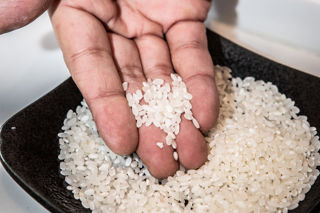
Tucked in the labyrinthine, sprawling walls of Tokyo station is a small shop selling, as many do, beautiful pottery, assorted condiments and kitchenware. However this boutique also stocks barrel upon barrel of rice. Akomeya, whose name is a pun on ‘rice shop’, is in many ways no different from all the other chic and intimidating boutiques you can find across Tokyo. The only difference is that this shop is for people who are as obsessed with rice as other shoppers might be with designer labels or third-wave coffee. Like in most Japanese rice shops, you can mill the grain to order, choosing the exact percentage of the bran to remove for the freshest, most flavourful rice. There are gift packs, handkerchiefs with maps of rice-growing regions, and beautiful tools for cooking, shaping and storing rice.
While you might think that this level of obsession is highly niche or an eclectic shop for overly-moneyed shoppers, there are around 30-40 branches of Akomeya, many of which are in Tokyo, as well as smaller rice shops in many neighbourhoods, each selling dozens of different varieties of Japanese rice. You can pick your rice by all 47 prefectures, by texture (stickiness and fluffiness), white or brown – the list goes on and on. It’s a serious cornerstone of the country’s culture.
And yet, if you live in the UK, you would never know this. You walk into a supermarket, and if you’re lucky there is one pack of Japanese-style rice, often labelled ‘sushi rice’. There is limited information about origin, and likely none about variety. For a Japanese consumer, this is the equivalent of going into a supermarket to buy some cheese and seeing one sad square simply labelled ‘cheese’ in the fridge, with no other information about what it is. (Which, to be fair, is not far off what happens when trying to buy cheese at lots of supermarkets in Japan.)
This is, however, slowly changing. Exports of Japanese rice to the UK are increasing, and some specialist retailers are now offering rice not only by prefecture, but also locally milled in the UK. The increase in choice is wonderful but – as in Akomeya – quite overwhelming. The names for different rice varieties – like koshihikari and nijinokirameki – are often fairly long, and even translated into English aren’t really descriptive of the rice’s qualities.
A good comparison might be apples. Apples aren’t named ‘tart and green’, or ‘red and sweet’. Instead, they have fun and fairly random names like ‘Granny Smith’, ‘Pink Lady’ or ‘Braeburn’; Japanese rice is the same. Although the differences are visually subtler with rice than with apples, the variations in quality, aroma and texture are carefully monitored by growers and consumers alike.
The subject of Japanese rice is culturally, economically and culinarily complex. Within Japan, rice matters to priests and politicians as much as chefs. This guide introduces some of the most widely-available varieties in the UK, but only scratches the surface of all there is to learn about rice in Japan.
No guide to Japanese rice would be complete without introducing koshihikari. If you know any Japanese rice variety, it will be this one. A third of all rice grown in Japan is koshihikari, and it grows all across Japan, although koshihikari from Niigata is particularly prized. It was developed after the war in 1956, and is known for its long-lasting flavour and aroma, which makes it a good choice for bento and onigiri.
The second most popular rice in Japan, accounting for nearly 10% of all rice grown, is hitomebore. The whimsical name of this variety – meaning ‘love at first sight’ – was controversial at first, but soon won over consumers. A cross between koshihikari and another variety, hatsuboshi, it’s primarily grown in Miyagi, and was developed to be resistant to cold snaps. It’s known for its distinctive shine and stickiness.
Another koshihikari cross, akitakomachi is a versatile and sweet rice primarily grown in Akita. It’s named after Ono no Komachi, a Heian-era poet known for her beauty. The poet’s beauty is so legendary in Japan, that her name became a byword for beauty, and was used for this rice to emphasise its glossiness and perfection.
While lots of rice varieties may be associated with a particular prefecture, they can generally be grown in several prefectures across Japan. Not so with nanatsuboshi, which is exclusively grown in Hokkaido. The name, meaning seven stars, is the Japanese term for the Big Dipper. It’s the most widely grown rice in Hokkaido, and has been awarded the highest grade for rice – ‘Special A’ – every year since 2010.
Yumepirika is another relatively new rice that was developed especially for Hokkaido’s cold climate. It was developed in 2004, and has a distinctively soft, sweet and sticky texture. In fact, it’s so soft you might need to slightly reduce the amount of water you use when cooking it, if you prefer rice with more of a chew. The name is a combination of the Japanese word for dream (yume), and the Ainu word for beautiful (pirika), the language of the indigenous people of Hokkaido.
This variety of rice easily has the most My Little Pony-esque name of any rice variety: rainbow sparkle. It’s also the newest variety on this list, launched in 2022 to be less susceptible to climate change, and the increasingly scorching Japanese summers. It has a higher yield than koshihikari, large grain size and is disease resistant, as well as having a beautiful shine, texture and flavour.
Shikiyutaka is a variety derived from Koshihikari, but it produces up to 1.5 times the yield. It's loved for its strong sweetness, large grains and pleasantly chewy texture, but what makes it really stand out is the softness of the grains when they cool. This means they're perfectly suited to onigiri and bento boxes, as the quality of the rice remains high long after it is cooked.
A packet of Yamagata’s famous tsuyahime immediately stands out because of its distinctive red and green logo. Tsuyahime’s production is rigidly controlled, and its production guidelines come with strict controls on artificial fertilisers and pesticides, as well as growing regions. This is the perfect rice to choose if you’re looking for rice that has a lower environmental impact, as well as a distinctive sweetness and umami.
The best way to learn what rice you like is, of course, to try some. So pick up a few varieties, give them a taste, and find out which one is your favourite.
Please sign in or register to send a comment to Great British Chefs.